Fourteen seconds. That’s all it took Ronda Rousey to finish Cat Zingano in February 2015, still the fastest armbar in the modern Unified Rules era.[3] Numbers like that aren’t accidents. They’re the fingerprint of a judo system transplanted, almost whole, into a cage. Ronda Rousey’s judo-to-MMA style: throws, armbar entries, and competitive legacy isn’t just a chapter in MMA history, it’s a blueprint that grapplers, including plenty of us on the BJJ side of the mat, still study today.
Rousey’s path ran from the judo mats of the Beijing Olympics, where she won bronze in 2008, straight into a UFC title reign built on one terrifyingly efficient idea: get the grip, get the hip, get the arm.[3][4] This article breaks down exactly how that system worked, why it dominated early opponents, where it eventually hit a wall, and why her 2026 comeback against Gina Carano gave the whole story one more unforgettable chapter.[4][15]
Key Takeaways
- Judo-built foundation: Rousey’s Olympic judo background (2008 bronze medal) shaped a clinch-first, throw-to-top-position game that most early opponents simply weren’t trained to counter.[3][4]
- Armbar specialist: Nine of Rousey’s professional wins came by armbar, and her first eight pro fights all ended that way, several in under a minute.[3][13]
- Speed records: Her first four pro bouts totaled just 2 minutes and 18 seconds of combined fight time, and her 14-second finish of Cat Zingano remains a historic benchmark.[3]
- A real limitation: FightMetric data show Rousey landed only 32% of significant strikes from distance while opponents landed 50% against her, a gap that showed up painfully in her 2015 loss to Holly Holm.[13]
- 2026 comeback: At 39, Rousey returned to finish Gina Carano by armbar in 17 seconds on Netflix’s first MMA card, closing her story on the same judo-based terms it began.[4][11][15]
From Tatami to Octagon: How Ronda Rousey’s Judo-to-MMA Style Took Shape
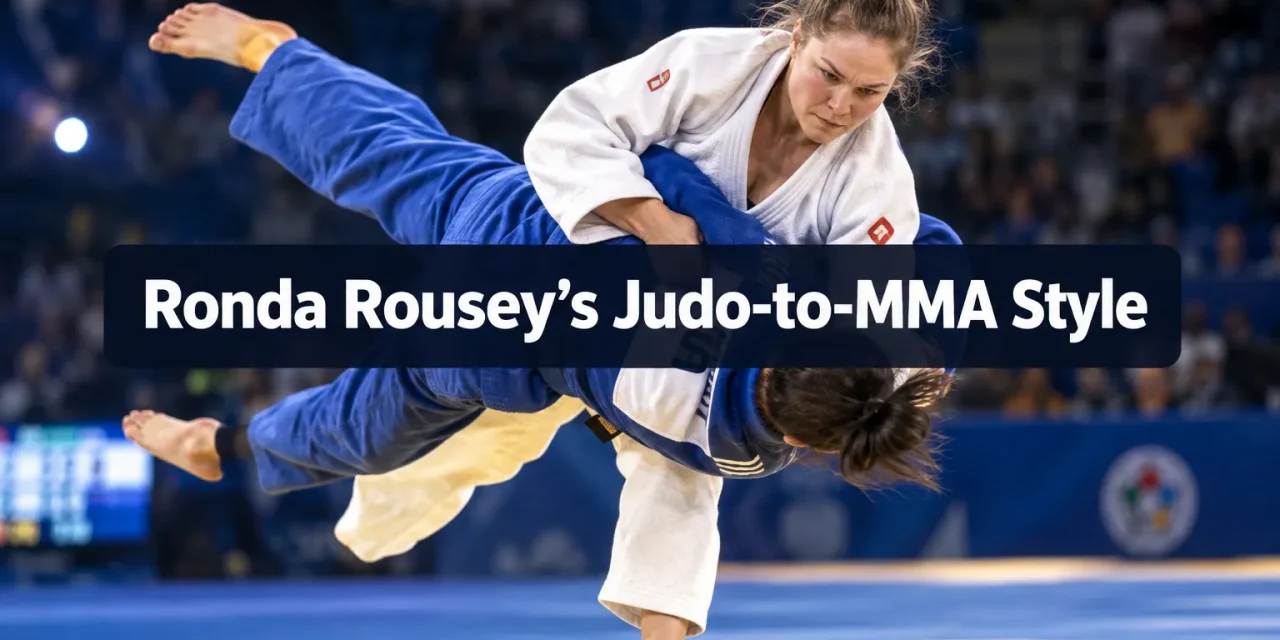
Long before “armbar” became shorthand for Rousey highlight reels, it was simply her best technique on the judo mat. She competed at the elite international level and took home Olympic bronze in 2008, building years of grip-fighting, footwork, and throwing mechanics that most fledgling MMA fighters of that era never had time to develop.[3][4] When she transitioned into professional fighting, she didn’t reinvent herself as a striker or a wrestler, she brought her judo game with her, almost unchanged, and let opponents walk into it.
That decision mattered because judo and Brazilian Jiu-Jitsu, while cousins in the grappling family tree, solve problems differently. Judo prioritizes the throw as the finishing move; BJJ treats the ground as home base. Rousey’s genius, and this is the part worth studying closely, was fusing the two: use the judo throw to get there, then finish like a jiu-jitsu artist once she arrived. If you’re curious how different jacketed grappling arts stack up against modern sport BJJ, our breakdown of Danzan Ryu jujitsu versus BJJ covers some of that same philosophical ground.
Coverage around her 2026 return repeatedly circled back to this origin story, noting that she “transitioned her talents into a remarkable career as a fighter” almost directly off the judo mat.[1][4] That lineage is the entire reason the phrase “Ronda Rousey’s judo-to-MMA style: throws, armbar entries, and competitive legacy” means something specific, it’s not generic ground-and-pound. It’s a system.
The Throws: Clinch Entries, Hip Throws, and Sacrifice Throws in Ronda Rousey’s Judo-to-MMA Style
Here’s where the judo really shows up. Rousey’s fights almost always followed the same opening sequence: close distance, win the clinch, and off-balance her opponent before they realized grappling had even started.
Her go-to entries included:
- Collar-and-elbow or head-and-arm ties to control posture and set up kuzushi (the off-balancing moment every judo throw depends on).
- Hip throws (o goshi style) that load an opponent across her hip and drop them flat on their back, instantly surrendering top position to Rousey.
- Body-lock trips and foot sweeps when an opponent resisted the hip throw, redirecting their weight instead of forcing it.
- Sacrifice throws, where Rousey would drop her own base to pull an opponent down with her, landing already in a dominant position rather than scrambling for one.
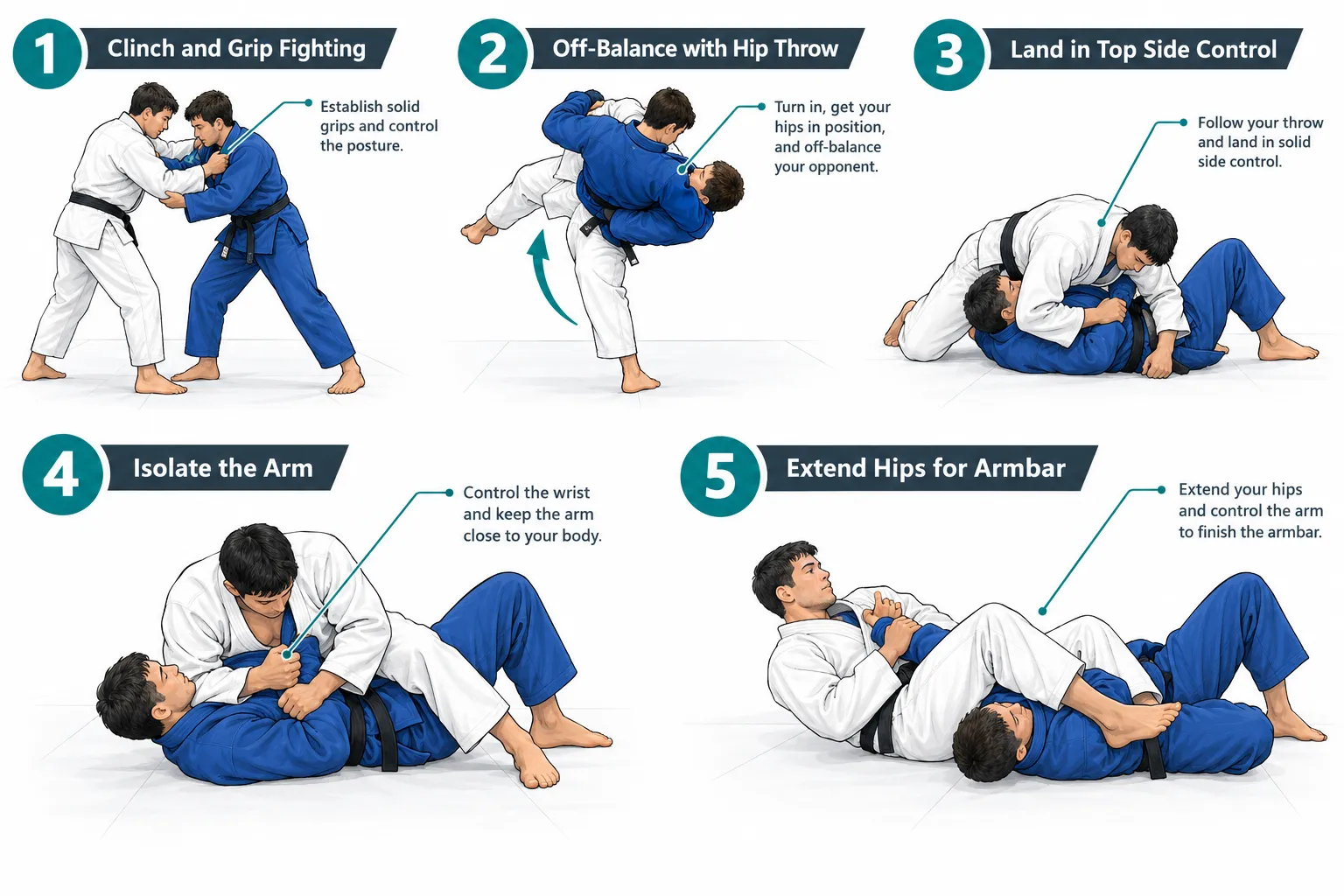
What made this so effective wasn’t raw strength, it was timing most strikers and wrestlers in early women’s MMA had never faced. Judo throws are built around using an opponent’s forward pressure against them, and Rousey’s opponents, trained mostly in boxing or wrestling, kept giving her exactly the pressure she needed. Once she landed the throw, she wasn’t improvising. She already knew where the fight was going next: straight into top position, and straight toward the arm.
If you want to see how grapplers capitalize once they land in that top spot, our guide to side mount top attacks walks through the same control-before-submission logic Rousey relied on.
Armbar Entries: The Finishing System Built From Judo
This is the signature. ESPN’s 2026 feature on Rousey’s career calls the armbar the technique she “built her MMA game around”, isolating an opponent’s arm and using hip and body leverage to hyperextend the elbow for rapid finishes.[3] It’s a pure judo-to-newaza (ground technique) transition, executed with a speed that caught the sport off guard.
The pattern repeated itself with uncomfortable consistency for her opponents:
- Three amateur wins by armbar, all in under a minute.
- Her first eight professional MMA fights all ended by armbar.[3]
- Five of those eight finishes came in less than sixty seconds, most inside the first round.[3]
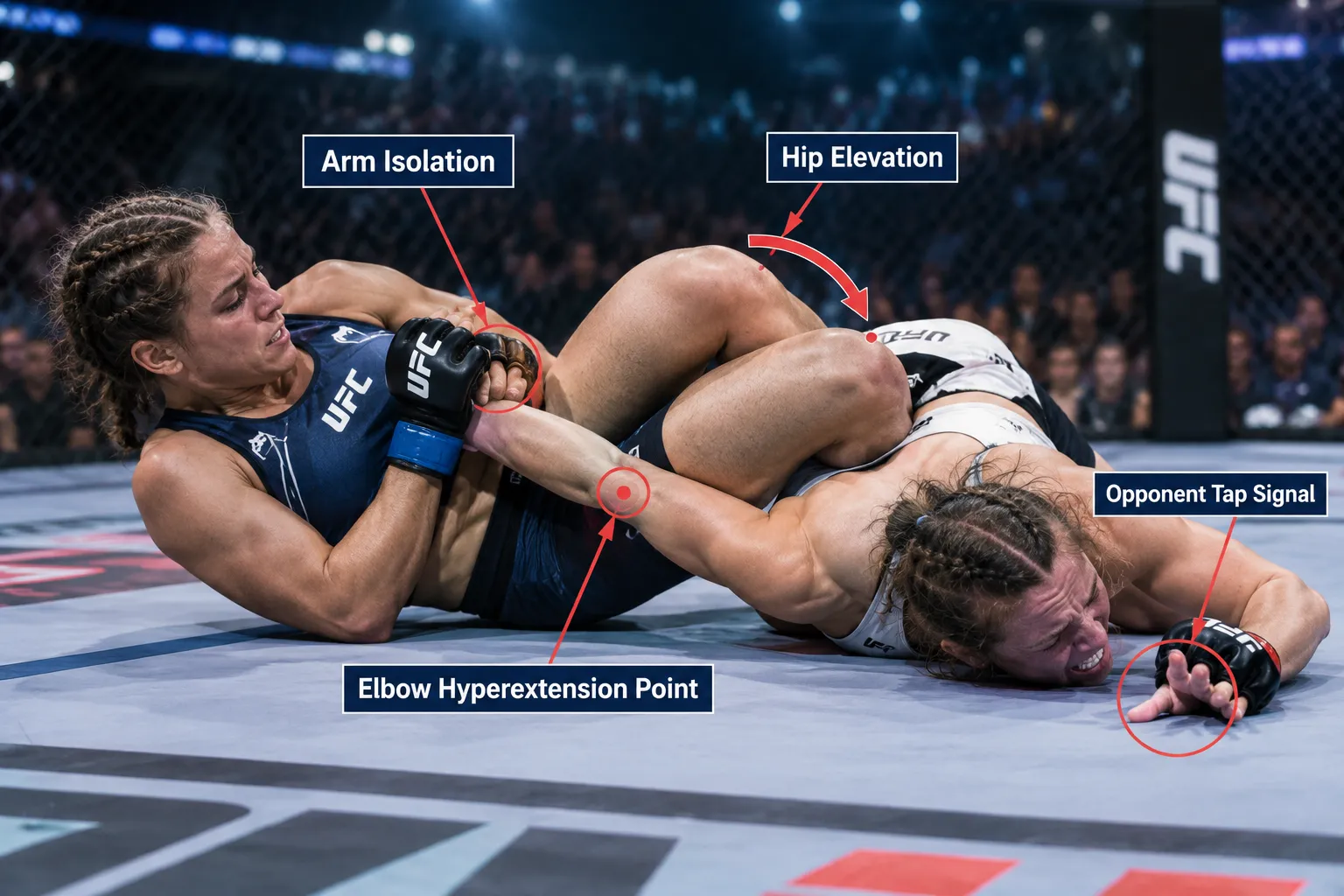
Rousey’s armbar entries typically came from one of two places: directly off a judo throw into an arm-trapping top position, or from the clinch itself, snapping straight into an armbar as an opponent tried to create space. Either way, the mechanics stayed true to judo fundamentals, control the arm early, keep the hips elevated, and finish before the opponent can defend the elbow joint. For BJJ practitioners working on their own submission chains, it’s a useful reminder that strong guard control and arm isolation go hand in hand, whether you’re pulling guard or getting swept into bottom position.
“Her armbar wasn’t a gamble, it was the destination her whole game plan was built to reach.”
Rousey’s combined finishes over Liz Carmouche, Miesha Tate, and Cat Zingano tie her with current stars Mackenzie Dern and Mayra Bueno Silva for the most armbar submissions among women’s bantamweights, a stat that still gets cited when analysts compare generations of finishers.[3]
The Numbers Behind the Legacy: Speed Records and Finishing Rate
Stats don’t lie, and Rousey’s are almost cartoonishly lopsided. Her first four professional fights ended via armbar in 25, 49, 25, and 39 seconds, a combined total of just 2 minutes and 18 seconds of cage time across four entire fights.[3] Her 14-second armbar finish of Cat Zingano in February 2015 remains the fastest armbar in the modern Unified Rules era.[3]
Here’s the broader finishing profile, compiled from ESPN’s career review:[13]
| Category | Result |
|---|---|
| Career decisions | Zero, never gone the distance |
| Submission wins | Nine, all by armbar |
| KO/TKO wins | Three (pre-2026 comeback) |
| First-round UFC title finishes | Five, most by any fighter in title-fight history |
| Fastest wins | Alexis Davis (16-second KO), Zingano (14-second armbar), Bethe Correia (34-second TKO) |
That last row matters: more finishes under 35 seconds than any other UFC fighter, male or female.[3][13] Combined with her 13-2 record after the 2026 Carano bout and her 10th career submission win, the body of work makes a strong case that Rousey’s judo-based finishing rate has no real parallel in the sport’s history.[4][15]
Strengths and Limitations of the Armbar-First Game
No system is unbeatable forever, and Rousey’s wasn’t either. The same judo-first approach that produced historic finishing speed also came with a clear vulnerability once opponents started training specifically to avoid the clinch.
Strengths:
- Overwhelming speed advantage against opponents unfamiliar with elite grip fighting and throws.
- A finishing chain (throw → top position → arm isolation) that required opponents to solve three problems in sequence, usually within seconds.
- Psychological pressure, opponents knew the armbar was coming and often still couldn’t stop it.
Limitations:
- Distance striking was never the foundation of her game, and it showed when fights left the clinch range. FightMetric data show Rousey landed only 32% of significant strikes from distance, while her opponents landed 50% against her.[13]
- Her 2015 loss to Holly Holm is the clearest case study: Rousey attempted 59 distance strikes, landing just 13, more than double the total distance strikes she’d thrown across her first six UFC fights combined.[13]
- Opponents who studied tape eventually learned to circle away from the clinch entirely, denying her the judo entries that made the rest of the system work.
That Holm fight, and the follow-up loss to Amanda Nunes in 2016, pushed Rousey into her first retirement.[14] It’s a useful lesson for grapplers at every level: a dominant game plan still needs a backup plan when the fight refuses to go where you want it. For anyone training to escape bad positions when a bigger or more athletic opponent controls the exchange, our piece on mount escapes against larger opponents covers some of the same adaptive thinking.
The 2026 Comeback: Gina Carano, Netflix, and a Rewritten Ending
Nearly a decade after her last professional fight, Rousey stepped back into competition on May 16, 2026, facing fellow MMA pioneer Gina Carano at Inglewood’s Intuit Dome.[4][15] The result: an armbar finish in 17 seconds, Rousey’s 10th career submission win, pushing her record to 13-2, and then an announcement that she was retiring from MMA once again.[4][15]
The bout carried weight beyond the scorecard. It headlined the first MMA card ever broadcast on Netflix and the first non-UFC MMA event promoted by Jake Paul’s Most Valuable Promotions, a milestone for how major fights get distributed to fans.[11][12] Analysts framed it as a real test of MMA’s viability outside the UFC umbrella, with the Intuit Dome card doubling as proof that streaming platforms can host championship-caliber combat sports.[11][12]
Before the fight, Rousey said the bout would “smash” the pay record for women in combat sports, a claim BBC analysis tied directly to her legacy as the first woman signed by the UFC and one of the biggest draws in MMA history.[6] AP reporting described a disciplined training base in Las Vegas, emphasizing the structure and support Rousey lacked earlier in her career.[7] In her own words, she wanted to “rewrite her ending” and relearn to love the sport enough to leave it on her own terms.[9][12] Finishing with a clean, judo-rooted armbar against another grappling-savvy pioneer did exactly that, it restored the narrative of Rousey as a dominant finisher rather than the fighter remembered mainly for her striking-heavy losses.[4][9][12]
Interestingly, Rousey’s return wasn’t limited to the cage. In March 2026, she made a surprise appearance at AEW Revolution, nearly three years after her last WWE match, before pivoting into the Carano fight.[1] Commentators have long noted how her judo-based takedowns and armbar setups echo in the way she builds pro-wrestling sequences, legitimate grappling instincts showing up even in a performance context.[1]
Ronda Rousey’s Competitive Legacy and Influence on Today’s Grapplers
Rousey’s armbar statistics still shape how modern fighters and grapplers think about submission-first game plans. ESPN explicitly compares her numbers to current stars Mackenzie Dern and Mayra Bueno Silva when discussing the most feared armbar artists in women’s MMA.[3] In September 2026, UFC strawweight champion Mackenzie Dern reportedly voiced interest in a “dream fight” against Rousey, framed as a generational clash between two of the sport’s most dangerous armbar specialists.[10][3]
That’s the real measure of a legacy: not just the medals or the finishes, but whether active champions are still talking about you as the standard. Ronda Rousey’s judo-to-MMA style: throws, armbar entries, and competitive legacy gave the sport a template, clinch, throw, isolate, finish, that grapplers from judo, BJJ, and wrestling backgrounds continue to study and adapt.
For BJJ practitioners specifically, there’s a direct lesson in how Rousey paired explosive top-position entries with textbook arm isolation. If you’re working on tightening up your own submission defense against that kind of pressure, our guide to footlock defense applies the same core principle, control the limb before it controls you. And if you’d rather watch technique than just read about it, browse our library of jiu-jitsu videos for more throw-to-submission breakdowns.
Conclusion
Ronda Rousey didn’t invent the armbar, and she didn’t invent the hip throw. What she did was something rarer: she took a complete judo system, entries, throws, top position, finish, and proved it could dominate an entirely different sport almost overnight. The speed records, the undefeated start, the eventual adjustment period against Holm and Nunes, and the full-circle 17-second finish over Gina Carano in 2026 all tell the same story from different angles, a grappler who trusted her base and built a career, and a legacy, on top of it.[3][4][13][15]
Whether you’re a white belt just learning your first armbar from guard or a competitor chasing your next medal, there’s something worth borrowing from Rousey’s approach: get good at the entry, trust the technique, and don’t wait around once you’re in position. Come back and check it with us again soon as we keep breaking down the grapplers who’ve shaped combat sports both inside and outside the gi. Oss!
References
[1] Ronda Rousey Makes Shocking Return To Wrestling At Aew Revolution 2026 – https://sports.yahoo.com/wrestling/breaking-news/article/ronda-rousey-makes-shocking-return-to-wrestling-at-aew-revolution-2026-024926989.html [3] Ronda Rousey Armbar Top Mma Gina Carano Mvp Promotions Mma Fight Card – https://www.espn.com/mma/story/_/id/48694276/ronda-rousey-armbar-top-mma-gina-carano-mvp-promotions-mma-fight-card [4] Ronda Rousey Vs Gina Carano Fight Rousey Wins With A 17 Second Submission – https://www.aljazeera.com/sports/2026/5/17/ronda-rousey-vs-gina-carano-fight-rousey-wins-with-a-17-second-submission [6] BBC Sport: Ronda Rousey pay record analysis – https://www.bbc.com/sport/mixed-martial-arts/articles/clypl0g3j44o [7] Ronda Rousey Gina Carano – https://apnews.com/article/ronda-rousey-gina-carano-71b8b460e35f515a83e3ea21ad9d574e [9] BBC Sport: Ronda Rousey rewrite her ending interview – https://www.bbc.com/sport/mixed-martial-arts/articles/c0mg7n1r4nxo [10] Ufc News Champion Wants Dream Fight – https://sports.yahoo.com/articles/ufc-news-champion-wants-dream-140542368.html [11] Netflix first MMA card coverage – https://apnews.com/article/ronda-rousey-gina-carano-71b8b460e35f515a83e3ea21ad9d574e [12] MVP Promotions and streaming MMA coverage – https://www.bbc.com/sport/mixed-martial-arts/articles/c0mg7n1r4nxo [13] Ronda Rousey Armbar Top Mma Gina Carano Mvp Promotions Mma Fight Card – https://www.espn.com/mma/story/_/id/48694276/ronda-rousey-armbar-top-mma-gina-carano-mvp-promotions-mma-fight-card [14] MMA News 2026 Ronda Rousey Exclusive Interview – https://www.nine.com.au/sport/combat-sports/mma-news-2026-ronda-rousey-exclusive-interview-return-fight-gina-carano-jake-paul-promotion-wwe-career-motherhood-training-camp-20260513-p5zxo6.html [15] Ronda Rousey Vs Gina Carano Fight Rousey Wins With A 17 Second Submission – https://www.aljazeera.com/sports/2026/5/17/ronda-rousey-vs-gina-carano-fight-rousey-wins-with-a-17-second-submission