A rear-naked choke can end a confrontation in under ten seconds. A missed takedown against a striker who never closes distance can end one even faster, the wrong way. That gap is exactly why the debate over BJJ vs MMA: What Brazilian Jiu-Jitsu Can and Cannot Do in a Real Fight keeps coming up in gyms, forums, and late-night arguments between training partners. Brazilian Jiu-Jitsu has earned its reputation as one of the most effective self-defense systems ever built, but “effective” and “complete” are not the same word. This breakdown separates what BJJ genuinely delivers once a fight gets physical from the phases of real violence it was never designed to solve alone.
Key Takeaways
- BJJ is a dominant tool once a fight hits the clinch or the ground, letting a smaller, technical person control and submit a larger, untrained attacker.[4][6][8]
- BJJ struggles with multiple attackers, weapons, and pure standup striking, gaps that show up repeatedly in real-world self-defense analysis.[1][2]
- In professional MMA, submissions decide roughly 23% of fights, while knockouts account for about 40% and decisions about 37%, proving grappling is major but not everything.[3]
- Police departments that added BJJ training saw real injury reductions, a documented 48% drop in officer injuries and 53% drop in arrestee injuries.[3]
- Around two years of consistent training is typically enough to confidently control an untrained opponent on the ground, though BJJ works best paired with striking or wrestling for full “real fight” readiness.[2]
Where BJJ Dominates: The Ground Game Advantage
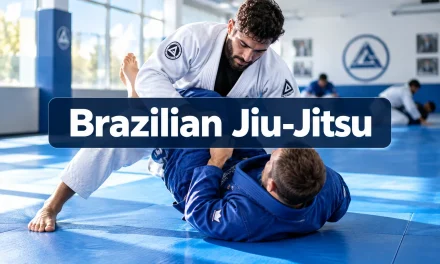
Brazilian Jiu-Jitsu earned its global reputation for one simple reason: most people have no idea what to do once they’re on the ground. Untrained attackers rely on size, adrenaline, and wild punches. The moment a fight gets tangled up, in a clinch, against a wall, or on the floor, a BJJ practitioner is operating in territory the other person has never studied.
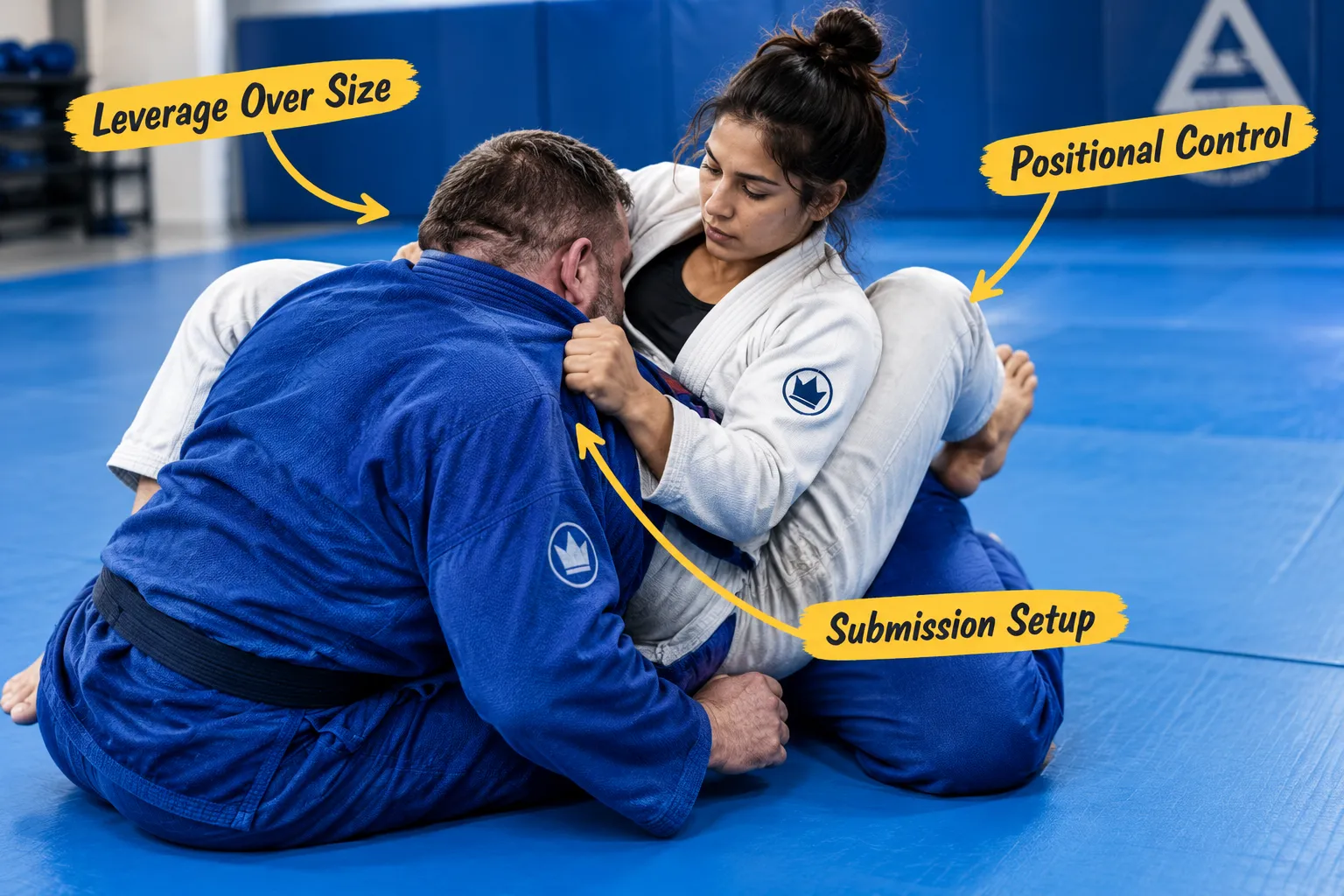
This is the heart of the art’s self-defense case. BJJ teaches leverage, positional control, and submissions that let a smaller or lighter person neutralize a much bigger attacker, which is precisely why multiple recent self-defense guides call it one of the most effective systems for one-on-one confrontations.[4][6][8][10] If a situation involves one unarmed attacker and ends up in a clinch or on the ground, BJJ offers a genuinely decisive edge, it exploits a phase of combat that untrained fighters are almost universally unprepared for.[4][5][6]
A few concrete advantages worth remembering:
- Chokes and joint locks end fights without heavy strikes, which can reduce injury risk and legal exposure compared to striking someone unconscious.[2][8]
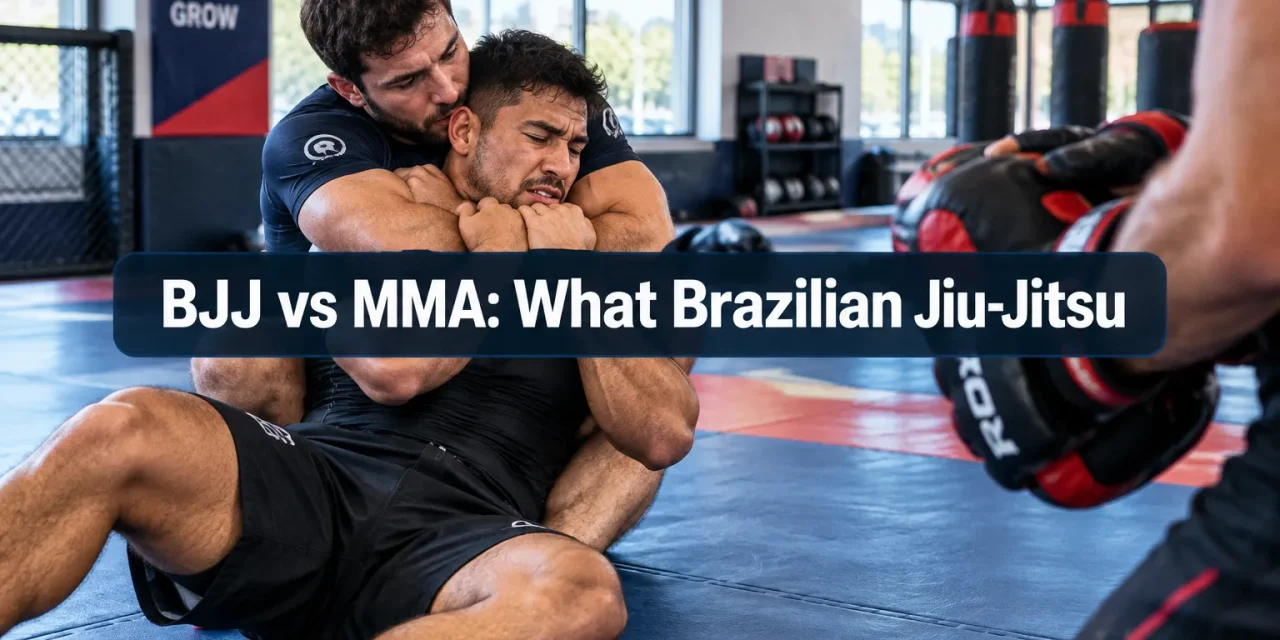
- Rear-naked chokes can render an attacker unconscious within seconds, offering a controlled way to stop an altercation.[8]
- Positional dominance (like back control or mount) lets you manage an opponent’s energy, buying time to de-escalate or wait for help.
- Size and strength matter less once the fight is grounded, which is the core reason BJJ became known as the great equalizer. If you want to go deeper on using leverage against a bigger, stronger opponent, our guide on handling size and strength mismatches breaks down the mechanics.
None of this is hype, it’s documented, repeatable, and why so many self-defense instructors build their curriculum around grappling fundamentals.
BJJ vs MMA: What Brazilian Jiu-Jitsu Can and Cannot Do in a Real Fight When Fists Start Flying
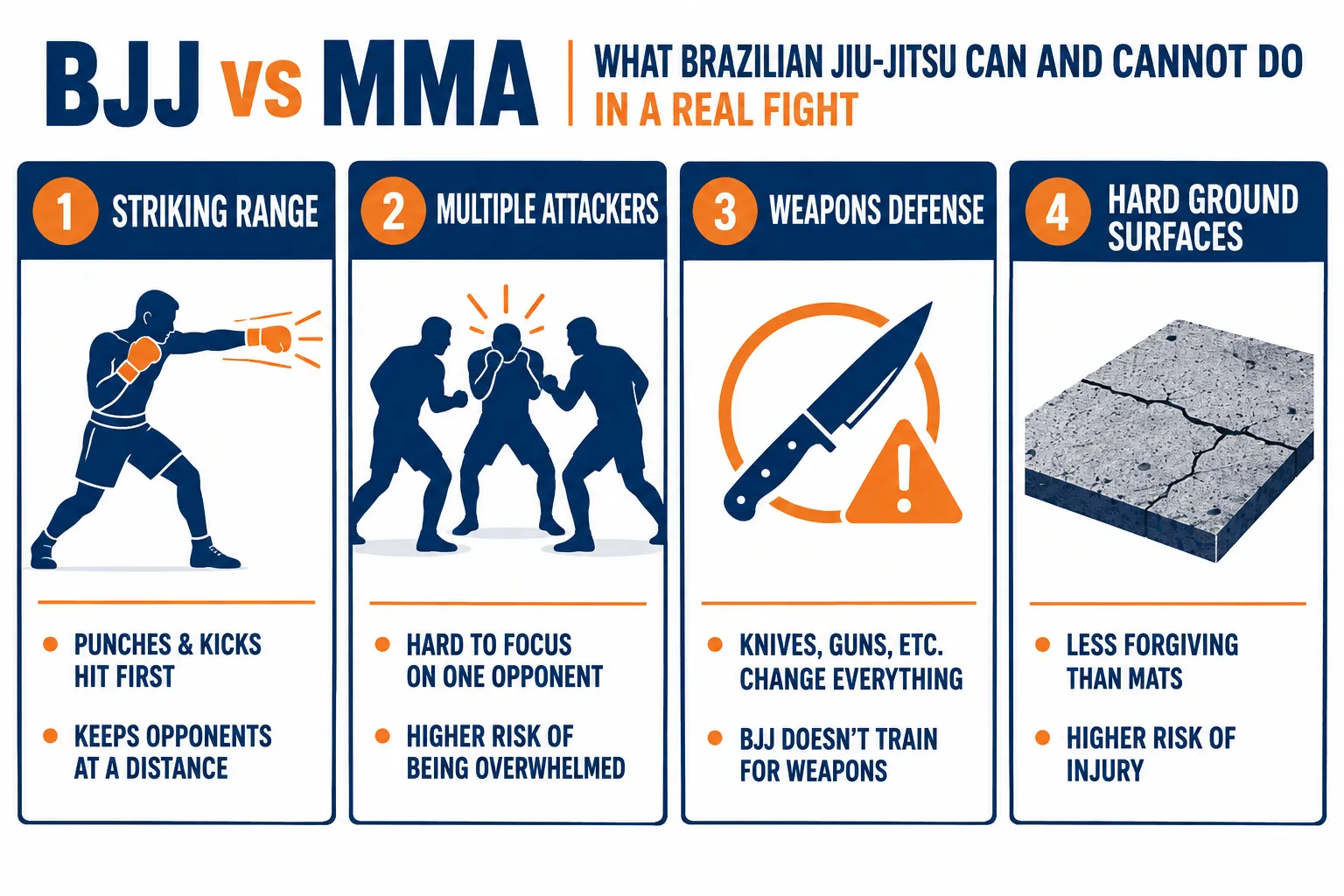
Here’s where the conversation gets honest. Most real confrontations don’t start on the ground, they start standing up, often with a shove or a punch. And that’s a phase where traditional sport BJJ training frequently falls short.[2][3]
Recent self-defense analyses point to four consistent limitations of modern, competition-focused BJJ:
- Limited standup striking work. Many BJJ gyms spend little to no time on punches, elbows, or head movement, leaving a gap against someone throwing hands before any clinch happens.[2][3]
- A gap between clean mats and messy reality. Sport BJJ is trained on padded surfaces with a single partner and rules. Concrete, broken glass, uneven footing, and adrenaline change everything.[2][1]
- Weapons defense is thin or absent in most curriculums. Grappling skill does not automatically translate into defending a knife or firearm threat.[2][1]
- Voluntarily going to the ground carries real risk outside a gym. Bystanders, hidden weapons, or a second attacker can turn a smart takedown into a dangerous mistake.[3][5]
A useful way to frame it: BJJ is outstanding at finishing a fight once it’s already entangled, but it does comparatively little to stop you from getting hit on the way there. That’s part of why a recent expert tier-list ranking placed MMA and boxing in the top “S-tier” for overall street readiness, because they cover striking, clinch, and ground, while BJJ landed in “A-tier”: essential, but risky if over-relied upon as a standalone system.
If you’re specifically weighing grappling styles against each other for self-defense purposes, it’s also worth reading how BJJ stacks up against another dominant grappling art in our breakdown of Judo or BJJ for a street fight.
Multiple Attackers, Weapons, and the Street: Where BJJ Hits Its Limits
This is the section every honest practitioner needs to sit with. BJJ shines in one-on-one, unarmed scenarios. It gets significantly shakier the moment variables multiply.
Consider the real difference between a dojo roll and a street altercation:
| Scenario Element | BJJ’s Strength | BJJ’s Limitation |
|---|---|---|
| One unarmed attacker | 🥇 Excellent, leverage and control dominate | , |
| Standing exchange before the clinch | Limited | Minimal striking defense in most curriculums[2] |
| Hard or uneven ground | Technique still works | Falls, joint strain, and surface hazards increase risk[1][2] |
| Multiple attackers | , | Going to the ground is dangerous with a second threat nearby[3][5] |
| Weapons involved | , | Most sport BJJ gyms don’t train weapon awareness or disarms[1][2] |
The takeaway isn’t that BJJ “fails” in these situations, it’s that no single discipline, BJJ included, guarantees safety once a confrontation gets complex. Recent commentary on self-defense effectiveness is consistent on this point: BJJ excels in one-on-one ground combat, but it was never built as a complete answer to every kind of violence.[2] That’s a fair and important distinction, not a knock against the art.
BJJ’s Role Inside MMA: Submissions, Control, and the Numbers
Inside the cage, the picture looks different, and the data backs it up. BJJ is often called the cornerstone of ground fighting in MMA, used to control opponents, escape bad positions, and close out fights with submissions.[9] Fans who grew up watching the Gracies prove this on early UFC cards aren’t wrong about BJJ’s impact, they’re just seeing one piece of a bigger puzzle.
Here’s what the numbers actually show in professional MMA:
- Submissions account for roughly 23% of all MMA victories, a huge chunk directly rooted in Jiu-Jitsu fundamentals.[3]
- Knockouts and technical knockouts make up about 40% of finishes, the largest single category.[3]
- Decisions account for roughly 37%, often shaped by grappling control even when no submission occurs.[3]
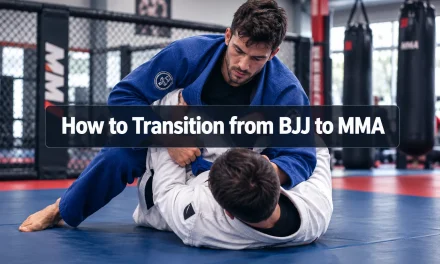
Those numbers tell an important story: grappling and submissions are a major win condition in MMA, but striking still produces the largest share of finishes outright.[3][9] That’s exactly why elite MMA fighters cross-train. BJJ gives them the tools to survive the ground and finish fights there, but boxing, Muay Thai, and wrestling cover the standing phase that decides who gets taken down in the first place. For a reminder of just how dramatic a submission comeback can look when BJJ fundamentals click at the highest level, check out our rundown of the best MMA comebacks won by Jiu-Jitsu submissions. It’s also worth keeping an eye on how organizations are investing in this crossover, the UFC’s BJJ Revolution live event series is a sign of how central grappling remains to combat sports culture.
“BJJ is what keeps you safe once the fight is already entangled; MMA is what helps you avoid being knocked out before you ever get to use your BJJ.”
Real-World Data: Police, Injuries, and Time to Competence
Numbers from outside the cage matter too, and one of the clearest comes from law enforcement. The Marietta, Georgia Police Department implemented consistent BJJ training for officers and tracked the results. After adoption, officer injuries during use-of-force incidents dropped by 48%, injuries to arrestees fell by 53%, and Taser use decreased by 23%.[3] That’s about as close to real-world, high-stakes proof as self-defense training gets, BJJ didn’t just help officers “win” encounters, it helped them control resistant individuals with measurably less harm on both sides.
On the training-time question, most practitioners want a straight answer: how long until BJJ actually works? Recent analysis suggests:
- Around two years of regular training (2-3 sessions weekly) typically gets a blue belt to a solid level of control against an untrained opponent.[2]
- Even 6-12 months of focused training meaningfully improves a smaller person’s ability to manage distance, clinch, and escape bad positions.[6][10]
- BJJ is not a shortcut or a “magic” fix, skills fade without maintenance, and consistency beats intensity.[6][10]
There’s also good news on long-term sustainability: BJJ competition injury rates run roughly 9-39 per 1,000 athlete exposures, generally lower than comparative figures reported for MMA and boxing.[1] That makes BJJ a sensible primary art for most people, something you can train for years without burning out your body, before layering in striking or full MMA sparring.
BJJ vs MMA: What Brazilian Jiu-Jitsu Can and Cannot Do in a Real Fight, Building a Complete Toolkit
So where does that leave the practical answer to BJJ vs MMA: what Brazilian Jiu-Jitsu can and cannot do in a real fight? BJJ is not a complete self-defense system on its own, and it was never advertised as one by the people who built it best. What it is: a phenomenally effective tool for the grappling and ground phases of a fight, backed by real data from competition, policing, and self-defense research.[1][2][3][4]
Experts consistently recommend pairing BJJ with:
- Boxing or Muay Thai, to cover punches, kicks, and standup distance management.[2]
- Wrestling or Judo, to control how and when a fight hits the ground, rather than hoping it does. If you’re curious how other grappling traditions compare technically, our look at Small Circle Jujitsu vs BJJ is a good companion read.
- Scenario-based awareness training, for multiple-attacker situations and environmental hazards that no mat can fully simulate.[2][3][7]
The trend lines point toward more integration, not less. As more gyms absorb lessons from law enforcement data and competitive MMA, expect hybrid curriculums that blend BJJ fundamentals with striking and situational awareness to keep expanding over the next few years.[2][3][7] If your goal is MMA competition, BJJ is non-negotiable. If your goal is street-ready self-defense as fast as possible, MMA or boxing may get you functional sooner, but BJJ remains the single best long-term investment for controlling a larger, resistant attacker without excessive damage.
Conclusion
The honest answer to BJJ vs MMA: what Brazilian Jiu-Jitsu can and cannot do in a real fight isn’t a knock on the art, it’s a map of where to focus next. BJJ wins the clinch, wins the ground, and wins the argument about controlling a bigger opponent with less harm done to both people. It does not, by itself, solve striking exchanges, multiple attackers, or weapons. The fix is simple and already baked into BJJ culture: keep rolling, keep learning, and consider cross-training in striking or wrestling to round out the gaps. Come back and check it with your own training partners, roll into the heart of the discussion, compare notes, and keep building a game that works everywhere a fight might take you. For newer practitioners wondering about the community’s traditions, it’s also worth learning what “Oss” actually means in Brazilian Jiu-Jitsu before your next class.
Oss!
References
[1] Is Brazilian Jiu Jitsu Good For Self Defense – https://www.bjjacademyfinder.com/blog/is-brazilian-jiu-jitsu-good-for-self-defense [2] Bjj And Self Defense Myth Or Reality – https://bjj-rules.com/en/bjj-and-self-defense-myth-or-reality/ [3] How Effective Is Jiu Jitsu Benefits And Risks – https://scienceinsights.org/how-effective-is-jiu-jitsu-benefits-and-risks/ [4] Is Bjj Good For Self Defense – https://jiujitsuauthority.com/blog/jiu-jitsu-for-beginners/is-bjj-good-for-self-defense/ [5] Is Jiu Jitsu Effective In Real Fight Street Fight – https://unanswered.io/guide/is-jiu-jitsu-effective-in-real-fight-street-fight [6] Bjj In 2026 An Honest Look At The Hype And The Reality – https://eathealthy365.com/bjj-in-2026-an-honest-look-at-the-hype-and-the-reality/ [7] Is Brazilian Jiu Jitsu Effective For Real Life Self Defence – https://graciebarra.com/europe/news/is-brazilian-jiu-jitsu-effective-for-real-life-self-defence/ [8] Bjj For Self Defense – https://rivalbjj.com/learn/bjj-for-self-defense [9] What Fighting Style Do Mma Fighters Use – https://www.mma-ninja.com/what-fighting-style-do-mma-fighters-use/ [10] Bjj For Self Defense – https://gymdesk.com/blog/bjj-for-self-defense