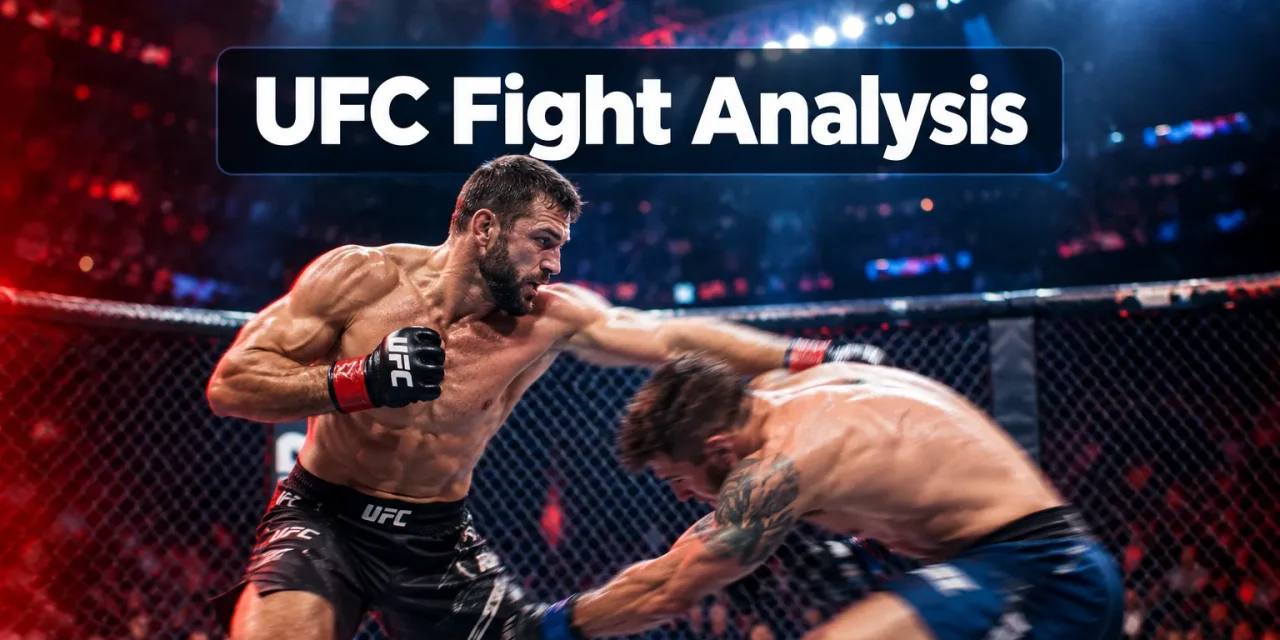
Shara Magomedov lands 62.8% of his significant strikes, the best mark among active UFC strikers with at least five fights and 500 attempts on record. [5] That number alone tells you almost nothing useful. It doesn’t tell you why he’s accurate, whether he’s hittable on the feet, or what happens when a wrestler closes the distance and drags him to the fence. Real UFC fight analysis isn’t about memorizing a single stat line, it’s about watching how striking, wrestling, and grappling interact round after round.
This guide breaks down the same framework coaches, analysts, and serious students use to study tape. If you’ve ever wanted to watch a fight like a grappler instead of a casual fan, this is the mat-level approach, rolling the lens from distance management all the way to submission chains.
Key Takeaways
- UFC fight analysis starts with distance and entries, how a fighter closes range tells you more than any single highlight reel.
- Striking accuracy and volume must be read together. A 61% accuracy striker and a high-volume pressure fighter win fights very differently. [1][5]
- Takedown chains and control time reveal wrestling IQ better than a single takedown number ever could. [2][10]
- Submission threats and defensive habits (hand fighting, hip escapes, grip breaks) separate live grapplers from fighters who are just surviving on the ground.
- A simple fight-study checklist, watched in layers, not once, turns raw stats into real scouting insight.
Why UFC Fight Analysis: How to Break Down a Fighter’s Striking, Wrestling, and Grappling Game Starts With Distance and Entries
Before you look at a single statistic, watch the feet. Every exchange in MMA, striking, clinch, or takedown, begins with someone managing distance. A fighter who controls range dictates the entire fight, and that control shows up long before a punch lands or a double-leg connects.
Here’s what to track on your first watch:
- Who owns the center of the cage? Fighters who circle off the fence usually have better footwork and more options.
- How does each fighter close distance? A level change into a shot, a jab-step into power punches, and a sudden clinch entry all tell you something different about a fighter’s game plan.
- What happens right after the entry? Does the striker get the takedown stuffed and eat a knee? Does the wrestler chain multiple attempts together?
This is the same principle grapplers already understand from live rolling, positioning before submission, base before attack. On the mats you learn that a bad entry gets you swept before you ever threaten a choke. In the cage, a bad entry gets you countered on the way in. If you’ve ever debated judo or BJJ for a street fight, you already know how much a clean entry changes everything that follows.
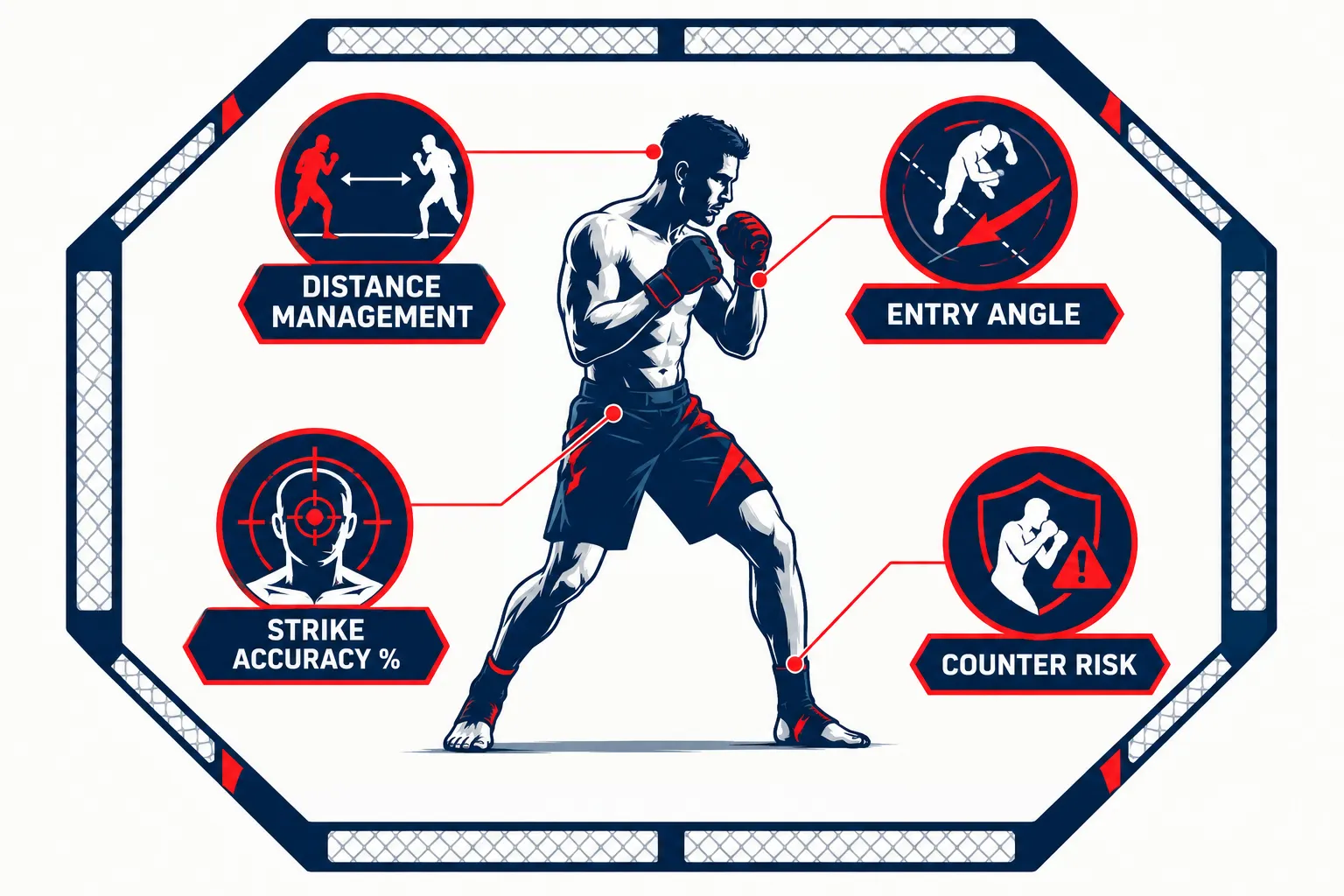
Reading Striking Distance Like a Grappler Reads Guard
Think of striking range the way you’d think about guard retention. A fighter standing at kicking range with good hips can reset the fight the same way a guard player resets frames. Watch for:
- Lead-leg checks and calf kicks that slow down forward pressure
- Pull-counters that punish sloppy entries
- Footwork resets after exchanges, fighters who stand still after trading are easier to pressure
Breaking Down the Striking Game: Accuracy, Volume, and Risk
Once you understand how a fighter gets into range, the next layer of UFC fight analysis is the striking exchange itself. Two numbers matter most: accuracy and volume, and they tell very different stories.
Official UFC stat leaders currently show Shara Magomedov at 62.8% accuracy, with Ciryl Gane and Chidi Njokuani close behind at 61.7%, Alex Pereira at 61.4%, and Sean O’Malley at 60.3%. [5][8] Compare that to the all-time record book, where Maurice Smith sits at an elite 75.3% across 182 attempts, Alistair Overeem at 74.3% over 962 attempts and 20 bouts, and Brock Lesnar at 73.3%. [1][10] Those benchmarks matter because a 61% accuracy mark today, while excellent by modern standards, still trails the most efficient strikers in UFC history.
Volume tells the other half of the story. Max Holloway holds the all-time record for significant strikes landed, 3,693 out of 7,666 attempts across 33 UFC bouts, a career built on relentless output rather than pure precision. [3][4] When you study tape, ask yourself:
| Striker Type | What to Look For | Example Benchmark |
|---|---|---|
| Precision striker | Fewer attempts, high accuracy, picks shots | Shara Magomedov, 62.8% [5] |
| Volume/pressure striker | High output, grinds opponents down | Max Holloway, 3,693 landed [3] |
| Historical elite accuracy | All-time efficiency benchmark | Maurice Smith, 75.3% [1] |
- Does the fighter land clean, or does the gas tank start running on empty by round three?
- Is their accuracy built on counters, or do they initiate?
- How often do they eat strikes while landing their own, a risk-reward trade that often decides close rounds?
A fighter’s striking profile also predicts how they’ll handle fatigue, which connects directly to how to improve cardio for BJJ, the same conditioning principles apply whether you’re grinding out a five-minute round on the mats or pacing a three-round decision in the cage.
Wrestling Breakdown: Takedown Chains, Entries, and Control Time
Wrestling is where a lot of casual analysis falls apart, because people watch for a single takedown instead of the chain of attempts that gets a fighter there. Georges St-Pierre’s 73.8% takedown accuracy across 122 attempts over 22 fights remains one of the gold standards in UFC history, with Karo Parisyan (66.2%), Valentina Shevchenko (61.5%), and Khamzat Chimaev (58.3%) also sitting near the top of the all-time efficiency boards. [2][10]
When you watch wrestling exchanges, don’t just count takedowns. Track:
- Entry setups, does the fighter use strikes to set up the shot, or shoot cold?
- Chain wrestling, do they recycle into a second or third attempt after the first is stuffed?
- Takedown defense, sprawl quality, underhooks, and whether they can get back to their feet
- Control time, minutes spent in dominant position matter more than the takedown itself
This is exactly the same logic you’d apply studying a dumog practitioner against a BJJ guard player, the entry style and chain attempts reveal far more than a single successful throw. And if a wrestler finishes a takedown with force, it’s worth remembering why you can’t slam in BJJ competition, a rule difference that makes MMA wrestling a genuinely different animal from sport grappling.
“A single takedown number is a snapshot. Control time and chain attempts are the whole film.”
Grappling and Submission Threats: Reading the Ground Game
This is home turf for anyone who trains BJJ, and it’s where your mat experience gives you a real analytical edge over casual fans. Once a fight hits the canvas, the questions change:
- Does the fighter advance position, or just hold on?
- Are there live submission attempts, or is the top player stalling for a decision?
- How does the bottom fighter defend, active hip movement and frame work, or passive turtling?
- What’s the submission grammar? A fighter threatening triangles, guillotines, or back attacks in sequence shows real BJJ fluency, not just a background on a resume.
Recent bout data makes this easy to see in action. In the UFC 323 rematch between Petr Yan and Merab Dvalishvili, the stat sheet showed 134 vs 139 significant strikes and 2 vs 5 takedowns with 2 vs 0 submission attempts, numbers that only make sense once you watch who was imposing wrestling pressure and who was managing distance to survive it. Meanwhile, Deiveson Figueiredo’s first-round finish loss to Payton Talbott, with 25 significant strikes landed against just 5, is a reminder that striking defense and early-round composure can end a fight before grappling ever enters the picture.
If you want to sharpen your eye for submission setups the way elite black belts do, study technical breakdowns like how to finish a triangle with the Craig Jones technique or the mechanics behind an electric chair submission, both show how small grip and angle details decide whether a submission attempt finishes or fizzles. And don’t ignore the defensive side: reviewing the five biggest guard passing mistakes will help you spot the same errors when a UFC fighter gets passed and mounted.
A Practical Checklist for UFC Fight Analysis: How to Break Down a Fighter’s Striking, Wrestling, and Grappling Game
Analysts who study tape professionally don’t watch a fight once and call it done. The widely echoed best practice is a layered rewatch: first for overall momentum, then for striking only, then for clinch and wrestling, and finally for decision-making under fatigue, always pairing numbers with specific moments instead of trusting aggregate stats alone.
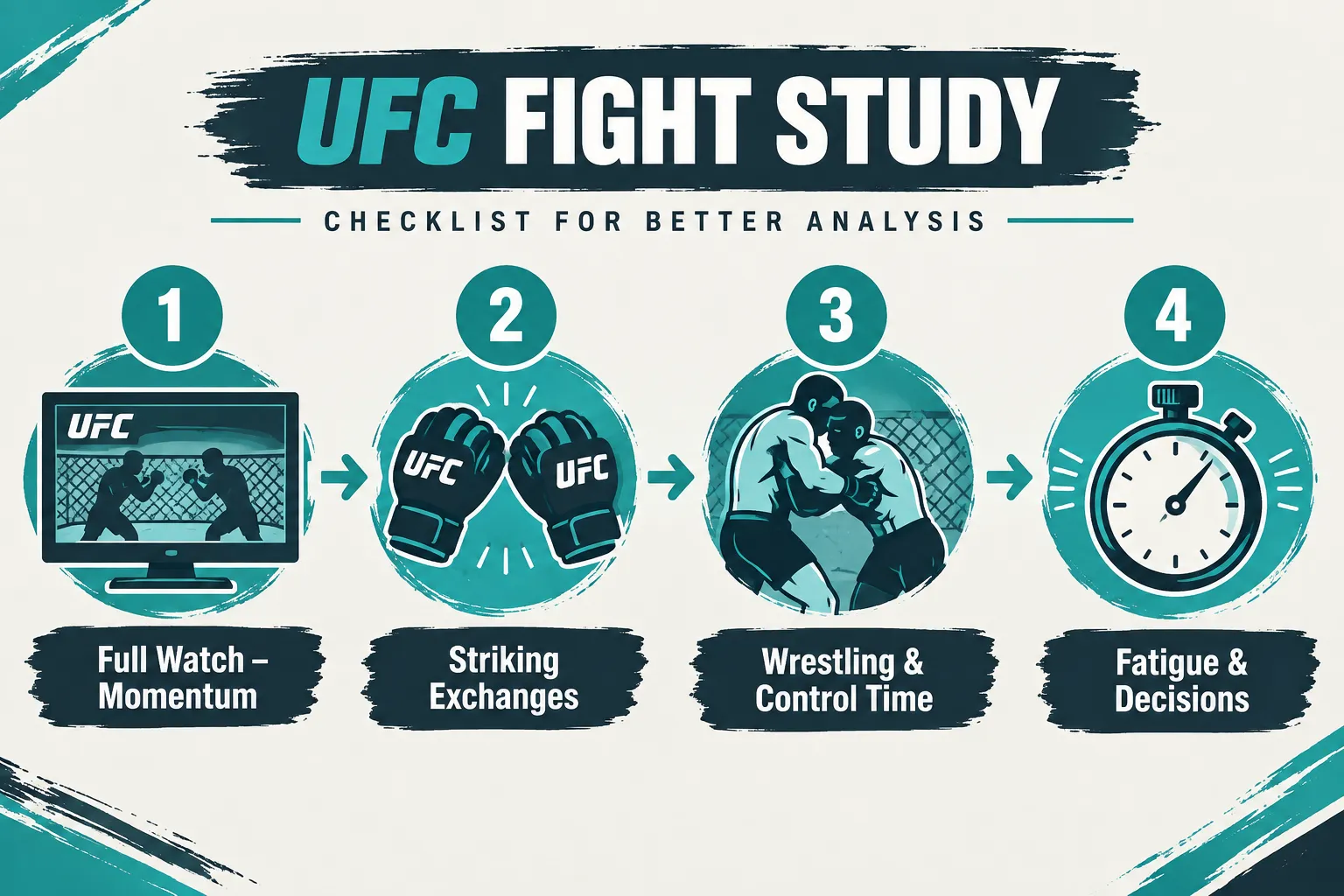
Here’s a simplified version you can use on your next fight night:
- First watch, momentum. No pausing. Just feel who controlled the overall flow and where things turned.
- Second watch, striking only. Log clean landed strikes, knockdowns, and who initiated versus countered.
- Third watch, wrestling and clinch. Count takedown entries (not just successes), chain attempts, and control time.
- Fourth watch, grappling and fatigue. Track submission attempts, defensive scrambles, and how sharp technique stays as gas tanks empty.
Keep a simple notepad or spreadsheet with these columns:
- Fighter name
- Significant strikes landed / attempted
- Takedowns landed / attempted
- Control time
- Submission attempts
- Momentum shifts (round and time)
This is the same discipline you’d bring to reviewing your own rolling footage, logging what actually happened instead of relying on gut feeling. The UFC’s growing investment in grappling-focused events, including the launch of UFC Jiu-Jitsu live events, shows just how much the promotion itself values this kind of technical literacy among fans.
Putting It Together: Style Matchups and Predicting Outcomes
Once you’ve logged striking, wrestling, and grappling data separately, the real skill is weighing how those three games interact. Style-matchup models used by analysts in 2026 quantify this directly: wrestlers beat strikers in roughly 58% of pairings, strikers beat BJJ-based grapplers around 54% of the time, and grapplers edge out wrestlers in close to 51% of matchups, with takedown accuracy, takedown defense, control time, and submission-chain threats weighted heaviest. [6]
You can see this framing play out in real previews. Gable Steveson’s Olympic-level wrestling against heavy-handed strikers, Alexander Volkanovski’s veteran precision against undefeated wrestling-pressure fighters, and Petr Yan’s striking craft against Merab Dvalishvili’s relentless pace are all framed the same way, as a tug-of-war between disciplines rather than a simple better-fighter-wins story. [9]
- Wrestler vs. striker: Watch takedown entries against counter-striking distance.
- Striker vs. BJJ grappler: Watch whether the grappler can close distance without eating clean shots first.
- Wrestler vs. BJJ: Watch submission defense once the wrestler secures top control.
The record book gives you the benchmarks, fighters like Movlid Khaybulaev at 75.0% takedown accuracy remind you what elite efficiency actually looks like. [10] Use those numbers as a baseline, then let the tape tell you the rest of the story.
Conclusion: Bring the Mat Mindset to the Cage
Breaking down a fight the right way isn’t about collecting stats for their own sake, it’s about connecting every number back to a moment you actually saw happen. Distance management sets up entries. Entries lead into striking exchanges or takedown chains. Takedowns lead into control time, scrambles, and submission threats. Every phase feeds the next, just like a good BJJ game plan.
Next time fight night rolls around, grab a notepad, run the four-step rewatch, and watch the fight the way you’d study your own sparring footage, layer by layer, detail by detail. Come back and check it with your training partners afterward; comparing notes is half the fun of being part of this community.
Oss!
References
[1] Sig Strike Accuracy – https://www.ufcalendar.com/ufc/stats/leaders/sig_strike_accuracy [2] Takedown Accuracy – https://www.ufcalendar.com/ufc/stats/leaders/takedown_accuracy [3] Sig Strikes Landed – https://www.ufcalendar.com/ufc/stats/leaders/sig_strikes_landed [4] Total Strikes Landed – https://www.ufcalendar.com/ufc/stats/leaders/total_strikes_landed [5] statleaders.ufc – https://statleaders.ufc.com/?fighter_status=1 [6] sportsbook-betwhale – https://sportsbook-betwhale.com/predictions/mma/ufc/ [8] Career – https://statleaders.ufc.com/en/career?fighter_status=1 [9] Blog – https://fightsignal.com/blog [10] Leaders – https://www.ufcalendar.com/stats/leaders