A fighter can hold a title in one division and still get argued out of the conversation for best fighter alive. That’s the strange magic of pound-for-pound rankings, the list that ignores weight class entirely and asks a much harder question. As of early October 2026, nearly every major men’s list has Islam Makhachev sitting at No. 1, trailed by Alexander Volkanovski and Justin Gaethje, a reflection of Makhachev’s 29-1 record and his move up to take the UFC welterweight title by unanimous decision over Ian Machado Garry at UFC 330 in August 2026[1][3][2][5]. That snapshot alone tells you how much weight these lists carry, and how much disagreement they create. This breakdown of UFC Pound-for-Pound Rankings Explained: How Fighters Should Be Compared walks through the criteria panels actually use, shows where today’s names land, and applies the method step by step so you can build your own list with confidence.
Grapplers know this debate well, it’s the same argument we have on the mats about who the greatest competitor of a generation is, gi or no-gi, regardless of weight class. Many of today’s top UFC names, from wrestlers-turned-strikers to submission specialists, built their games with heavy Jiu-Jitsu influence, so this conversation hits close to home for our community.
Key Takeaways
- Pound-for-pound rankings compare fighters across weight classes by asking who would be best if size were equal, not who has the most title belts.
- Major panels weigh five things: quality of opposition, divisional dominance, activity, skill versatility, and recent form.
- As of October 2026, Islam Makhachev leads nearly every men’s list, while Valentina Shevchenko tops most women’s lists ahead of Kayla Harrison and Zhang Weili[6][3].
- Outlets build lists differently, some use journalist voting panels with point scoring, others use statistical rating models like GOAT Rankings’ C-ELO system[2][6].
- Activity rules matter: most outlets require a fight in the past 6-12 months (or one booked), while MMA Junkie uses a stricter 24-month cutoff[7][8].
What “Pound-for-Pound” Really Means in MMA
Pound-for-pound rankings didn’t start in the UFC, boxing used the idea first to settle an obvious problem: a heavyweight and a flyweight will never share a cage, so how do you say one is “better” than the other? The answer is to strip weight out of the equation and compare pure fighting ability, dominance, and résumé. It’s a thought experiment, not a matchmaking tool. Expert commentary across major outlets consistently frames it the same way: pound-for-pound asks “who would be better if every fighter were the same size?” rather than “who has beaten more people”[6][7][10].
That distinction matters because it means a longtime dominant champion with fewer recent fights can still outrank a hot streak contender, and a smaller fighter who dismantles elite competition can leapfrog a heavyweight who simply hasn’t been tested. This is also why pound-for-pound rankings generate more mat-side arguments than almost any other topic in combat sports, everyone weighs the criteria a little differently.
The Core Criteria Behind UFC Pound-for-Pound Rankings Explained
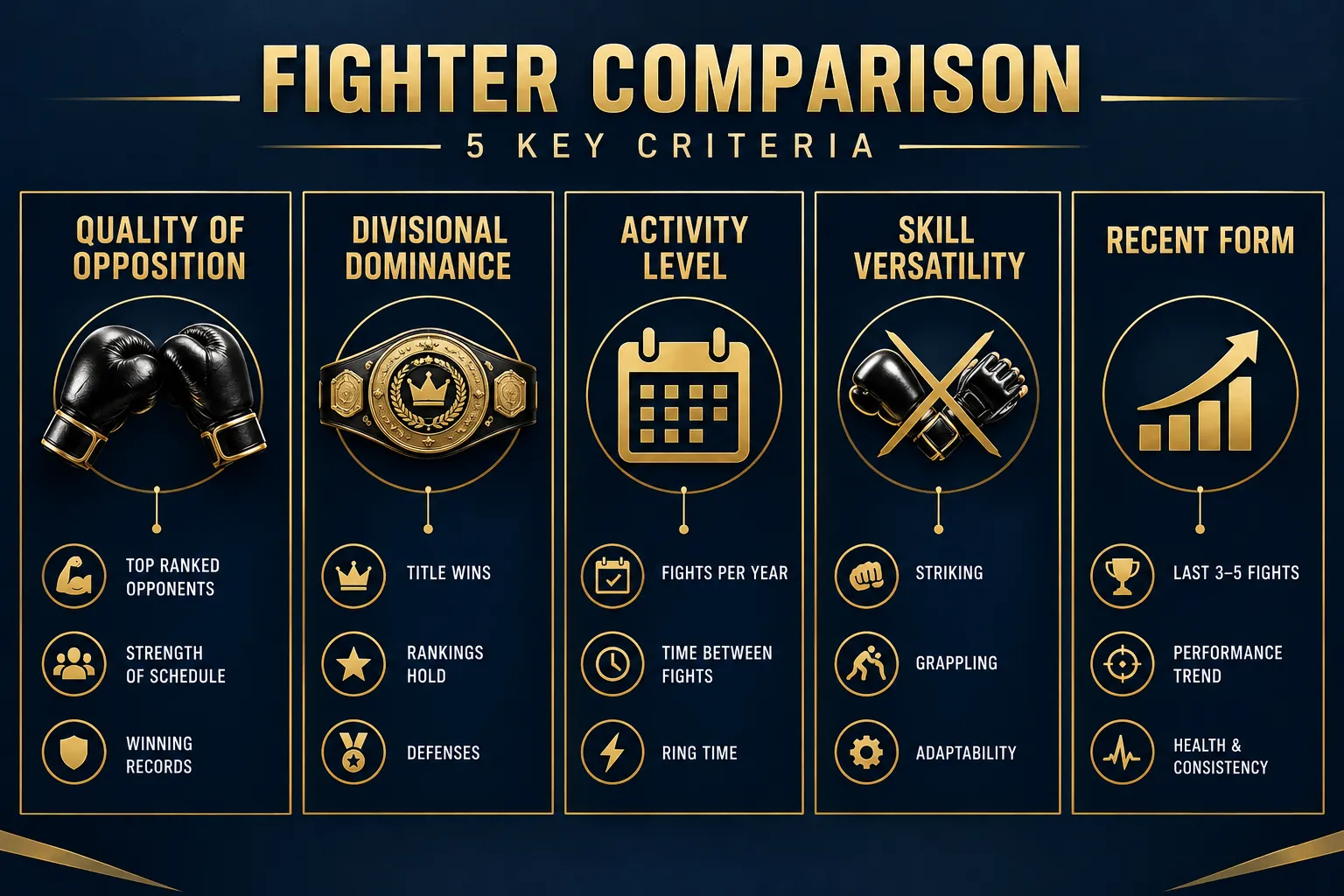
Every reputable outlet building UFC Pound-for-Pound Rankings Explained: How Fighters Should Be Compared leans on some combination of the same five pillars. MMA Junkie’s published methodology is one of the most transparent: it explicitly factors wins and losses, quality of opposition, finishing rate and dominance, and frequency of fights, while noting that catchweight bouts or fights outside a fighter’s primary division can swing a ranking either direction[7][8].
Here’s how the five criteria break down in plain terms:
- Quality of opposition, Beating a top-5 contender counts more than beating an unranked fighter. Panels look at who’s on the resume, not just the win total.
- Divisional dominance, How thoroughly a fighter controls their primary weight class: title defenses, finish rate, and how close opponents came to winning.
- Activity, Most outlets require a fight within a defined window (commonly 6-12 months) or a booked bout, or the fighter risks being dropped or flagged inactive[7][8].
- Skill versatility, Success across multiple disciplines (wrestling, striking, grappling) or multiple divisions adds pound-for-pound value, since it shows adaptability against different styles.
- Recent form, A statement win or a shocking upset can move a fighter several spots almost overnight, while a loss, even a close one, can drop them fast.
It’s worth noting that championship status and multi-division success get extra weight on most media panels, but they are not the whole story, a fighter without a belt can still rank highly on dominance and opposition quality alone[6][7].
Who’s on Top Right Now: Men’s and Women’s P4P Snapshot
Pulling from the major outlets tracking the sport in October 2026, here’s a simplified composite of where things stand. These lists shift fight to fight, so treat this as a snapshot rather than a permanent ranking.
| Rank | Men’s P4P (composite) | Women’s P4P (composite) |
|---|---|---|
| 1 | Islam Makhachev | Valentina Shevchenko |
| 2 | Alexander Volkanovski | Kayla Harrison |
| 3 | Justin Gaethje | Zhang Weili |
| 4 | Ilia Topuria | Natalia Silva |
| 5 | Merab Dvalishvili | Mackenzie Dern |
This table draws on aggregated rankings from CBS Sports, UFCalendar, and GOAT Rankings for the men’s side[1][3][4][5][2], and from Yahoo Sports’ October 2026 coverage plus CBS Sports’ women’s tables for the women’s side[6][3]. Natalia Silva’s climb into the women’s top five came after she captured UFC gold, a textbook example of how one title-winning performance can reorder an entire list[6].
On the men’s side, recent volatility has been just as dramatic. Joshua Van reportedly “soared” up multiple lists after a breakout performance at UFC 331, while Arman Tsarukyan crashed into the top 10 the same month, both moves happening within weeks of each other[9]. Betting and analytics sites like BetVictor also track broader top-nine and top-fifteen tables that include names like Petr Yan, Sean Strickland, Tom Aspinall, Alex Pereira, Ciryl Gane, and Khamzat Chimaev, all jostling for position as the fall 2026 fight calendar unfolds[5].
How Different Outlets Build Their Lists (Voting Panels vs Algorithms)
Not every pound-for-pound list is built the same way, and understanding the method behind a ranking is half the battle in evaluating it fairly.
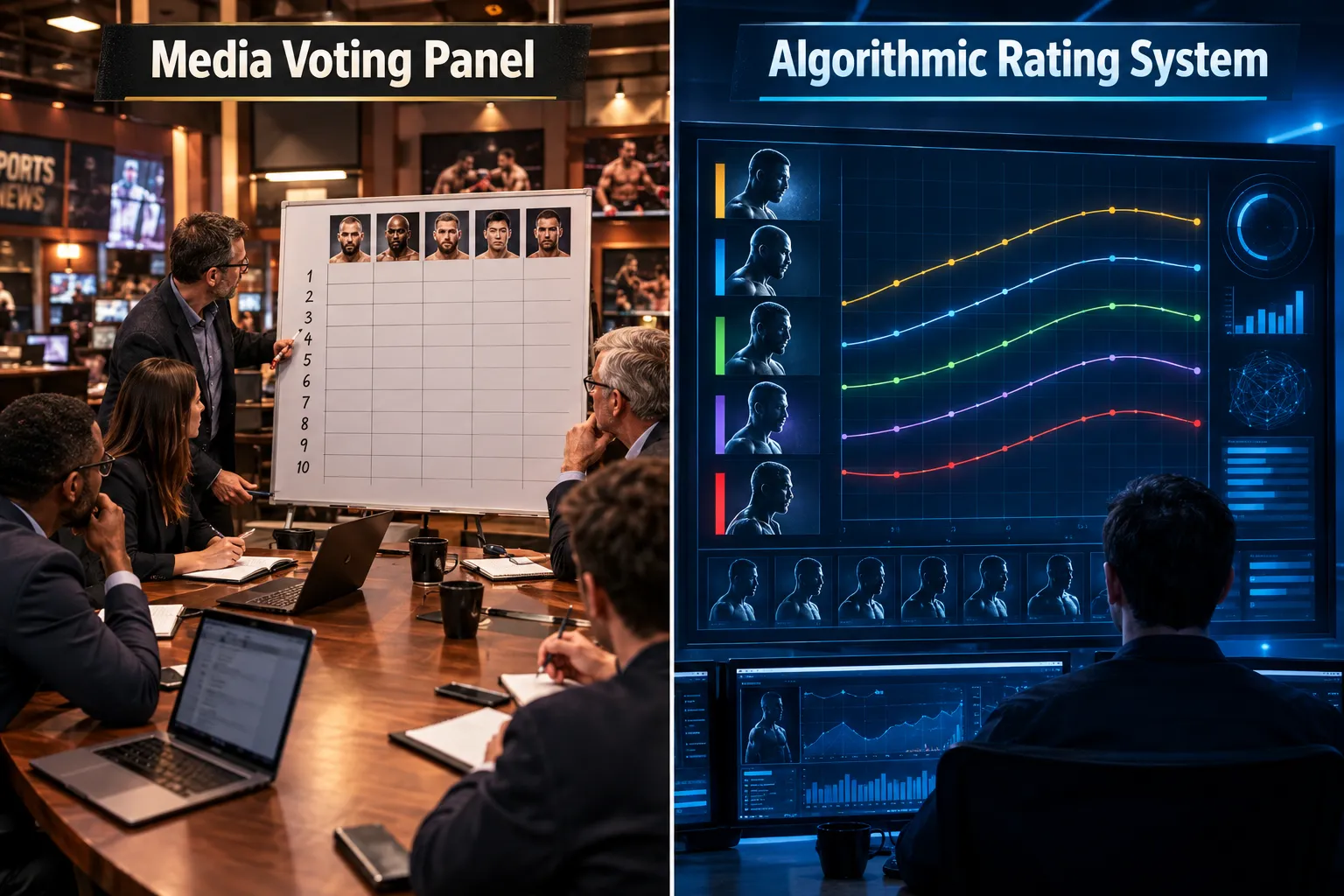
Media voting panels. One widely cited model uses a panel of eight journalists, a group that has included names like Ben Fowlkes, Chuck Mindenhall, Shaheen Al-Shatti, Petesy Carroll, Drake Riggs, Eric Jackman, and Conner Burks, who each rank fighters 1 through 10. A first-place vote is worth 10 points, a tenth-place vote is worth 1 point, and the totals are combined into a single table[6][9]. This method captures expert consensus but still carries individual bias, since each voter weighs the five criteria differently.
Statistical/algorithmic models. GOAT Rankings takes a different approach entirely, applying a C-ELO rating system that assigns each fighter a numerical score, often in the 1,500-1,600 range for the sport’s elite, and adjusts that score after every single bout based on the opponent’s own rating and the result[2]. It’s a more mechanical system, less about “feel” and more about math, and it currently has Makhachev at No. 1 followed by Volkanovski, Gaethje, Strickland, Yan, Topuria, Dvalishvili, and Charles Oliveira[2].
Aggregator reference pages. Sites like CBS Sports and UFCalendar maintain frequently updated pound-for-pound pages that function more like reference snapshots than independent opinions, pulling from official divisional standings and recent results, typically refreshed every few days as new events happen[1][3][4][5].
Whichever method a site uses, the baseline comparison rules tend to overlap: fighters are evaluated primarily within their main weight class, activity windows are enforced (ESPN’s rankings, for instance, require a fight in the past 12 months or a booked bout before a fighter can be reinstated after being dropped, while MMA Junkie applies a stricter 24-month cutoff), and performances outside a fighter’s primary division can help or hurt depending on how they go[7][8]. Importantly, suspensions for conduct or drug violations don’t automatically knock a fighter off a list, as long as they stay within the allowed inactivity window, they typically remain ranked[7][10].
Applying the Method: A Transparent Pound-for-Pound Walkthrough
Here’s how the five criteria actually play out when you apply them to a real fighter, using Islam Makhachev as the example since he currently tops nearly every list[1][2][3].
- Quality of opposition, Makhachev’s resume includes a title win over Ian Machado Garry at UFC 330 in a different weight class entirely, on top of his existing lightweight dominance[2].
- Divisional dominance, A 29-1 record with sustained control at lightweight before the welterweight jump gives him one of the strongest résumés in the sport[1][2].
- Activity, Comfortably within every outlet’s inactivity window, with no reinstatement issues to account for[7][8].
- Skill versatility, Winning a title in a second weight class is the single clearest pound-for-pound signal a panel can ask for; it directly demonstrates adaptability against bigger, different-styled opposition[6][7].
- Recent form, A unanimous decision win over a ranked contender in his most recent outing keeps his trajectory pointed upward rather than flat or declining[1][2].
Run any fighter through that same five-step checklist, Volkanovski, Gaethje, Shevchenko, Silva, whoever you’re debating with your training partners, and you’ll get a transparent, repeatable answer instead of a gut feeling. It won’t always match the “official” list, and that’s fine. The goal is a defensible process, not a guess.
If you enjoy tracking how a single performance reshuffles an entire hierarchy, the grappling world runs the exact same drama. Keep an eye on how no-gi world rankings shift after a big result or how a withdrawal can shake up an entire bracket, the logic of quality-of-opposition and recent form applies just as hard on the mats as it does in the cage.
Why Pound-for-Pound Rankings Spark So Much Debate
Here’s the honest truth: pound-for-pound lists are never going to produce full agreement, and that’s part of the appeal. Analysts across the industry stress that these rankings are conceptual debates, not official matchmaking documents, they’re built to spark conversation about dominance, versatility, and consistency rather than settle anything with finality[6][7][10]. A longtime champion who hasn’t fought in ten months can still rank above a surging contender who just won twice, and reasonable people will disagree about whether that’s correct.
Looking toward the rest of 2026, expect continued reshuffling as Makhachev, Volkanovski, Gaethje, Topuria, Strickland, and Shevchenko defend or chase titles. Recent history, Petr Yan’s upset wins, Joshua Van’s rapid climb, proves that any decisive finish in an upcoming title fight can reorder the top 10 across multiple outlets within days[2][6][9].
The crossover energy isn’t lost on the BJJ community either. The UFC’s own push into Jiu-Jitsu competition, including its BJJ Revolution live series and its inaugural open tournament in Las Vegas, shows how tightly grappling and pound-for-pound MMA conversations are becoming linked. And when fans argue about the “greatest regardless of weight,” it’s worth remembering that debate already has deep roots on our side of the sport, from arguments about Gordon Ryan’s case as a pound-for-pound great to Andre Galvao’s long run atop ADCC-level competition.
Conclusion
Pound-for-pound rankings aren’t a scoreboard, they’re a framework for an argument worth having. The strongest lists blend quality of opposition, divisional dominance, activity, versatility, and recent form into a transparent process, rather than a gut-feeling guess dressed up as fact. Once you know the criteria panels actually use, you can build your own list, defend it at the gym, and spot when a ranking shift, like Makhachev’s welterweight statement or Natalia Silva’s climb into the women’s top five, is backed by real evidence rather than hype.
Next time a title fight shakes up the top 10, run the fighter through the five-step checklist above before you repost a hot take. Come back and check it, these lists move fast, and we’ll keep breaking down how the comparisons hold up. Oss!
References
[1] Rankings – https://www.cbssports.com/ufc/rankings/ [2] goatrankings – https://www.goatrankings.com/rankings/p4p [3] cbssports – https://www.cbssports.com/ufc/rankings/men/200/p4p/ [4] Rankings – https://www.ufcalendar.com/rankings [5] Mens Pound For Pound – https://www.ufcalendar.com/rankings/mens-pound-for-pound [6] Mma Pound For Pound Rankings Oct 2026 Natalia Silva Breaks Into Top 5 After Claiming Ufc Gold 192429651 – https://sports.yahoo.com/mma/article/mma-pound-for-pound-rankings-oct-2026-natalia-silva-breaks-into-top-5-after-claiming-ufc-gold-192429651.html [7] Mma Divisional Rankings Ufc Pfl Rankings Weight Class – https://www.espn.com/mma/story/_/id/21807736/mma-divisional-rankings-ufc-pfl-rankings-weight-class [8] Mma Pound Pound Rankings" – https://www.espn.com/mma/story/_/id/24067525/mma-pound-pound-rankings" [9] Mma Pound For Pound Rankings Sept 2026 Joshua Van Soars After Ufc 331 Arman Tsarukyan Crashes Top 10 191104440 – https://sports.yahoo.com/mma/article/mma-pound-for-pound-rankings-sept-2026-joshua-van-soars-after-ufc-331-arman-tsarukyan-crashes-top-10-191104440.html [10] Mma Pound Pound Rankings – https://www.espn.com.au/mma/story/_/id/24067525/mma-pound-pound-rankings