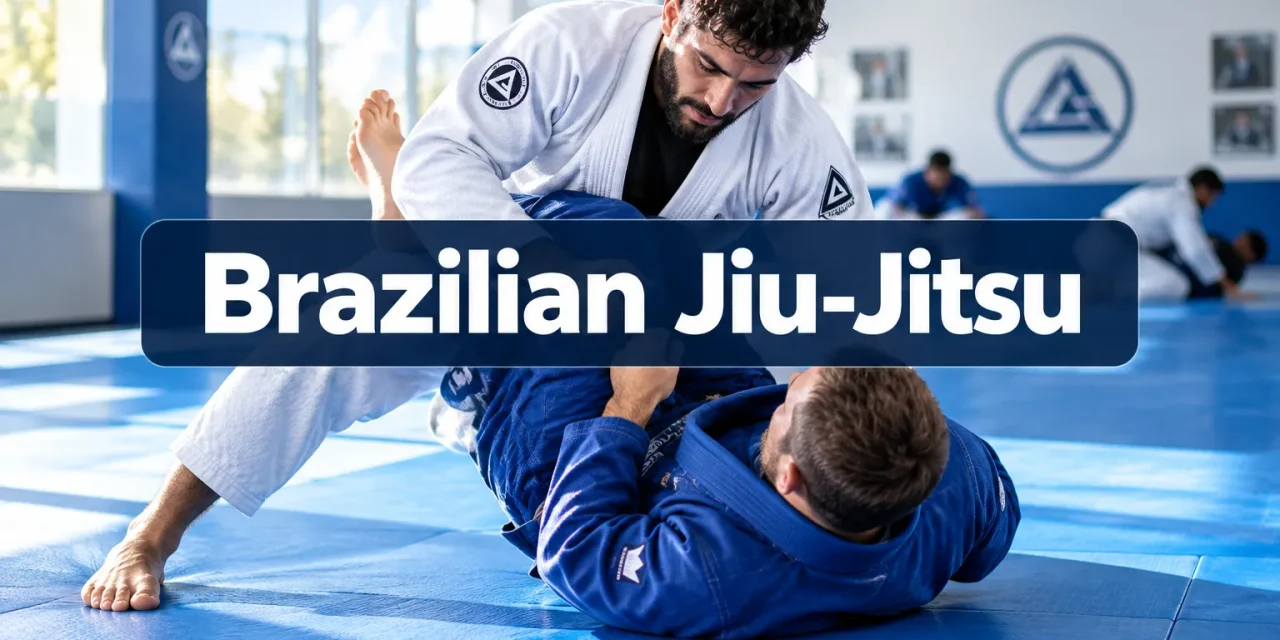
Roughly two out of three white belts never set foot in a competition. That single stat tells you everything about what Brazilian Jiu-Jitsu really is for most people walking through the academy doors, not a sport reserved for cage fighters and Worlds champions, but a lifelong practice built around problem-solving, fitness, and community. This Brazilian Jiu-Jitsu: Complete Beginner’s Guide to Positions, Belts, Rules, and Training is built for exactly that person: the one lacing up a white belt for the first time, unsure what “guard” even means, and wondering if they’ll survive their first roll.
BJJ is a grappling martial art. There’s no punching, no kicking, just takedowns, transitions, escapes, pins, joint locks, and chokes, almost all of it happening on the ground.[1][6] One person tries to pass the guard and pin; the other defends, sweeps, or hunts a submission from below.[1][6] It looks chaotic from the outside. It isn’t. Come back and check it with us, because by the end of this guide you’ll know exactly where you stand, literally and figuratively, on the mats.
Key Takeaways
- BJJ is positional, not just submission-based. Guard, side control, mount, and back control form a hierarchy you’ll learn before you ever chase a fancy choke.[1]
- The adult belt path has five colors: white, blue, purple, brown, and black, each with up to four stripes marking progress.[1][6]
- IBJJF rules govern most competition scoring and uniforms, with takedowns and sweeps worth 2 points, guard passes worth 3, and mount or back control worth 4.[1][8]
- New students aren’t thrown into hard rolling. Most gyms start beginners with drilling and light positional sparring for safety.[1][7][9][10]
- Two to three classes per week is the recommended starting cadence, scaling up once fundamentals feel stable.[2][10]
What Is Brazilian Jiu-Jitsu? Understanding the Ground Game
Brazilian Jiu-Jitsu is a grappling-based martial art and combat sport that uses leverage, timing, and technique to control or submit an opponent, regardless of size or strength differences.[1][6] Unlike striking arts, there are no kicks or punches in traditional BJJ sparring, the entire exchange is built around positioning, transitions, and finishing holds like armbars and chokes.[1]
A typical exchange follows a simple logic: one grappler works to pass the guard and establish a dominant pin, while the other uses their legs and hips, the guard, to defend, create sweeps, or set up a submission from underneath.[1][6] That’s the heartbeat of the art. Everything else, from belt rank to competition rules, is built on top of that core dynamic.
Brazilian Jiu-Jitsu Positions Every Beginner Must Know
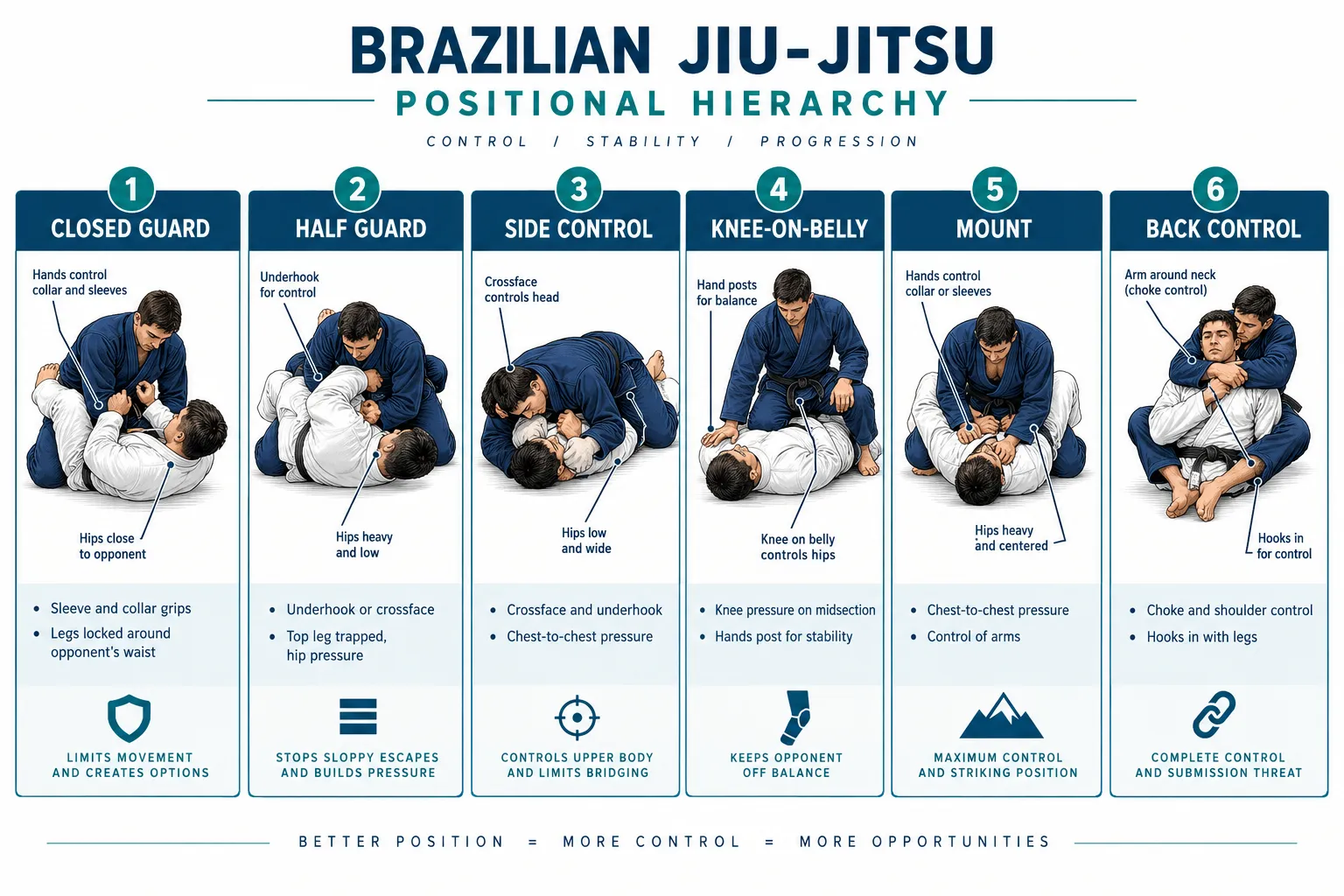
Before white belts ever learn a flashy submission, good instructors teach them where they are on the mat and whether that spot is good or bad. This positional hierarchy is the single most repeated teaching theme across beginner BJJ programs in 2026.[1]
The Core Positions, Bottom to Top
| Position | Who’s “winning” | What’s happening |
|---|---|---|
| Guard (closed/open) | Bottom player | Legs control distance; bottom player can sweep or attack |
| Half guard | Contested | One of top player’s legs is trapped between bottom player’s legs |
| Side control | Top player | Chest-to-chest pin, strong control, limited bottom options |
| Knee-on-belly | Top player | Mobile pin using knee pressure on the torso |
| Mount | Top player | Straddling the torso, high-value dominant position |
| Back control | Top/attacking player | Hooks in, seatbelt grip, prime submission real estate |
A smart early goal: have at least one reliable escape from each bad position, especially side control and mount, before worrying about anything fancy.[4] Escapes buy you time and keep you from getting pinned all class long.
Building Your First Submissions
Once escapes feel steady, most curricula layer in a basic sweep from closed guard, followed by one or two core submissions like the armbar or triangle choke.[4] You don’t need twenty submissions in month one, you need two or three you actually trust. For a deeper technical dive once you’re comfortable with fundamentals, check out a counter like the mechanic sweep as a response to the D’arce choke or a sneaky attack like the samurai sweep from quarter guard, both good examples of how specific positions open specific options.
“Positions before submissions” isn’t a slogan, it’s the entire architecture of how BJJ gets taught.
The Belt System: Brazilian Jiu-Jitsu Belts Explained for Beginners
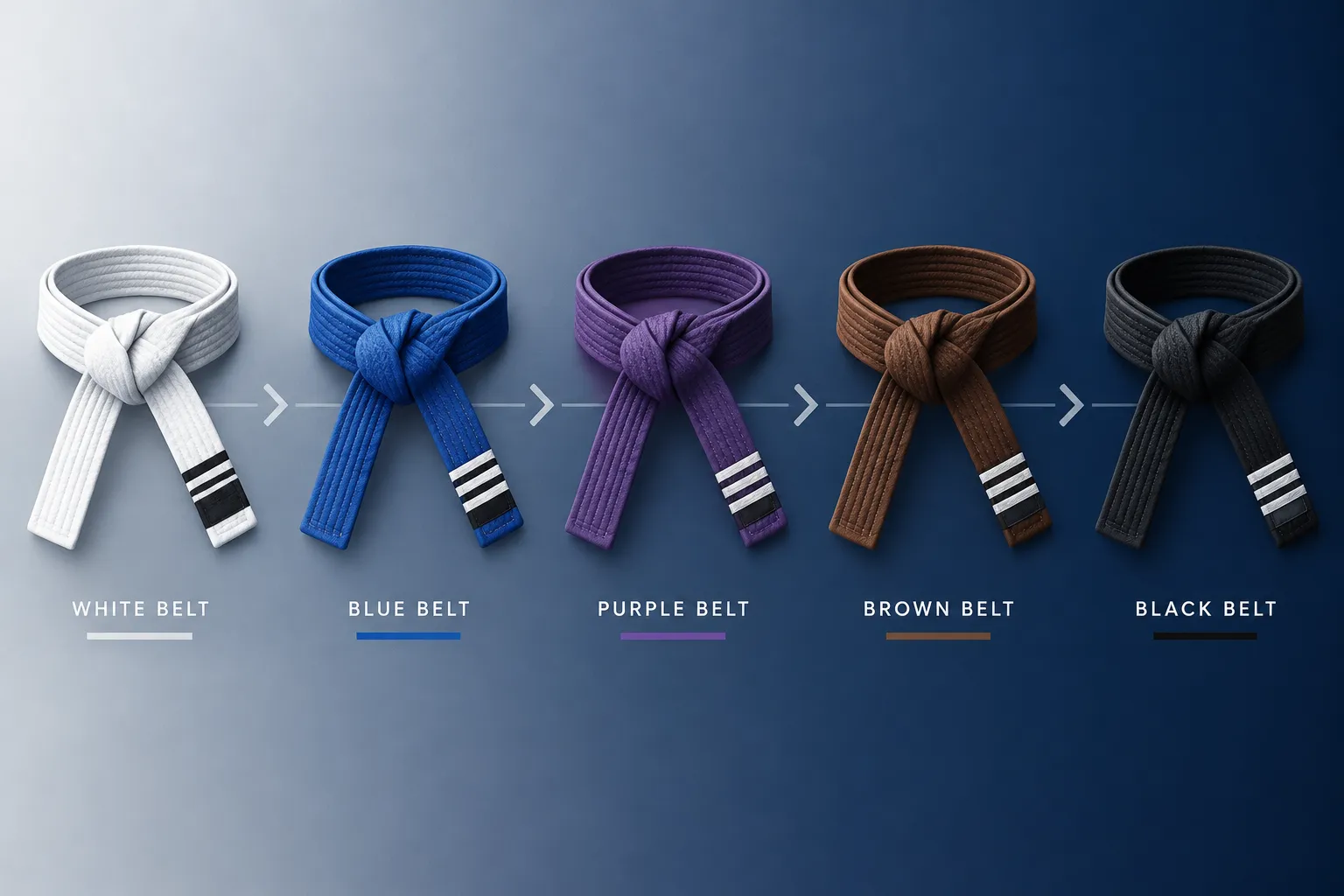
The adult belt progression in Brazilian Jiu-Jitsu has stayed consistent for decades and remains the standard in 2026: white, blue, purple, brown, and black.[1][6] Each belt, aside from black, can carry up to four stripes, small marks that track incremental progress between full promotions.[1][6]
- 🥋 White belt: Learning vocabulary, basic movement, and survival.
- 🔵 Blue belt: Building a real game plan; often the longest belt for many practitioners.
- 🟣 Purple belt: Refining details, starting to help teach newer students.
- 🟤 Brown belt: Polishing an already-complete skill set.
- ⚫ Black belt: Recognized expertise, and the start of a new phase of learning, not the end.
Promotions are earned through time on the mat, demonstrated skill, and an instructor’s judgment, there’s no universal point system like in some other martial arts. If you’re wondering how that conversation even happens, it’s worth reading up on how to ask your coach about a belt promotion the right way, and it helps to see just how far a blue belt can take someone by comparing a blue belt’s skill level against an average untrained person. Milestones matter at every level, even reaching black belt is a career-defining moment worth celebrating, as seen in Helena Crevar’s black belt achievement.
Brazilian Jiu-Jitsu Rules: Scoring, Submissions, and Competition
When it comes to competition, the International Brazilian Jiu-Jitsu Federation (IBJJF) remains the primary rules authority referenced across the sport, with other federations like Japan’s JBJJF explicitly aligning their uniform regulations with the official IBJJF rulebook as of 2025.[8] That means learning IBJJF scoring basics gives you a working knowledge of competition rules almost anywhere in the world.
Under the IBJJF Rule Book (version 6.1), points are awarded as follows:[1][8]
- 2 points, takedown, sweep, or knee-on-belly
- 3 points, guard pass
- 4 points, mount or back control
- Submission, an immediate win when an opponent taps to a choke or joint lock, regardless of the score
Matches can end by submission, points, referee decision, or penalties. If you’re planning to step onto a competition mat, it’s worth checking event-specific details ahead of time, resources like the IBJJF Jiu-Jitsu Con 2026 event guide are a great way to see how seminars and rule briefings are structured around major IBJJF gatherings.
Your First Brazilian Jiu-Jitsu Class: What Training Actually Looks Like
Walking into your first class is the hardest part, and it’s far less intimidating than most people expect. A typical beginner class follows a predictable rhythm:[1][6][9][10]
- Warm-up, light cardio and movement drills (shrimping, bridging, rolls)
- Technique instruction, usually one or two moves taught step by step
- Partner drilling, repeating the technique with a partner, cooperatively
- Positional sparring or light rolling, depending on the gym and your experience level
New students are rarely thrown straight into hard rolling. Most academies ease beginners in with drilling or light-resistance rolling against experienced partners so the first weeks stay safe and manageable.[1][7][9][10] If you’re the kind of person who likes to study outside the gym too, a few solid BJJ instructional DVDs and resources for beginners can reinforce what you’re drilling in class.
Training Frequency and Physical Prep: Brazilian Jiu-Jitsu Complete Beginner’s Guide to Training
Consistency beats intensity in the early months. Most recent beginner roadmaps recommend starting with 2-3 classes per week, which gives your body and nervous system enough recovery time while still building skill momentum.[2][10] Once fundamentals, basic escapes, guard retention, simple sweeps, feel stable, bumping up to 3-4 sessions a week is a reasonable next step, and keeping a simple training journal of positions and techniques can speed up learning while helping you avoid overtraining.[2][4]
Before day one, or in parallel with early classes, it helps to nail a handful of foundational movement patterns:
- Shrimping (hip escape)
- Bridging
- Technical stand-up
- Breakfalls
- Framing
On the conditioning side, aim for roughly 30 minutes of easy aerobic work (Zone 2, about 60-70% max heart rate) plus a few baseline mobility checks: a 45-second dead hang, a comfortable deep squat hold, and pain-free neck bridges. None of this is mandatory to start, plenty of people begin BJJ out of shape and get fit through the process, but it smooths the transition. And if your training is happening at home between classes, setting up a safe space with proper jiu-jitsu mats for your garage is worth the investment.
Mat Etiquette and Safety: The Unwritten Rules of BJJ
BJJ culture runs on respect, and most of that respect is expressed through etiquette rather than rules written on a wall. A few non-negotiables show up across nearly every beginner guide:[1][3][5][7][10]
- ✅ Tap early, tap often. If a submission feels tight or painful, tap clearly, verbally saying “tap” if your hands are trapped, and all action stops immediately.
- ✅ Listen when the coach speaks. Side conversations during instruction waste everyone’s time and can create unsafe moments.
- ✅ Control your body. Avoid flailing limbs or falling without control, that’s how training partners get hurt, not from clean technique.
- ✅ Communicate with partners. A quick check-in about injuries or intensity level before rolling prevents most avoidable problems.
- ✅ Bow in, show up on time, keep gear clean. Small habits that signal you respect the space and the people in it.
These habits matter regardless of style, Gracie, Machado, 10th Planet, gi or no-gi. The mat doesn’t care about your lineage; it cares whether you’re a safe, attentive training partner.
Realistic Expectations: Competition, Recreation, and the Long Game
Here’s the honest picture: roughly 43.6% of BJJ practitioners have competed within the past two years, but around 66% of white belts have never competed at all. That’s not a flaw in the system, it’s proof that BJJ works as a complete practice on its own, whether or not you ever step onto a competition mat. For context on how grappling fundamentals translate against other backgrounds, it’s interesting to see how a college wrestler matches up against a jiu-jitsu purple belt, a reminder that different styles bring different strengths to the mat, and BJJ rewards patience over raw athleticism.
If competition ever does call to you, the path typically looks like: solidify your defensive game at white belt, build a real offensive game plan at blue belt, and start entering local or regional IBJJF-sanctioned events once your coach agrees you’re ready. There’s no rush. Most of the sport’s greatest champions spent years at white and blue belt before ever stepping onto a competition podium.
Conclusion: Your Next Roll Starts Here
Brazilian Jiu-Jitsu rewards patience, curiosity, and consistency far more than it rewards athleticism alone. You now know the positional hierarchy that governs every exchange, the five-belt path from white to black, the IBJJF scoring basics behind modern competition, and what an actual beginner class looks like from warm-up to rolling.
Next steps:
- Find a local academy and watch a class before you join
- Commit to 2-3 sessions a week for your first few months
- Learn one escape from side control and one from mount before anything else
- Keep a simple notebook of positions and techniques you drill
The mats are patient. Everyone who’s ever earned a black belt once tapped out as a nervous white belt. Come back and check it with us as you keep rolling into the heart of the art, Oss!
References
[1] What Is Bjj – https://www.jitsai.com/what-is-bjj/ [2] How To Learn Brazilian Jiu Jitsu – https://www.bjjacademyfinder.com/blog/how-to-learn-brazilian-jiu-jitsu [3] Jiu Jitsu Classes For Beginners – https://www.bjjacademyfinder.com/blog/jiu-jitsu-classes-for-beginners [4] Bjj For Beginners Complete Guide – https://rollbook.app/blog/bjj-for-beginners-complete-guide/ [5] Beginner Basics – https://brazilianjiujitsu.blog/category/beginner-basics/ [6] What Is Brazilian Jiu Jitsu – https://www.hiltibjj.de/en/magazine/what-is-brazilian-jiu-jitsu.html [7] Beginners Guide – https://www.bjjsubs.com/content/articles/beginners-guide [8] Ibjjfrule – https://www.jbjjf.com/rules/ibjjfrule/ [9] Beginner Jiu Jitsu Classes – https://www.bjjacademyfinder.com/blog/beginner-jiu-jitsu-classes [10] Getting Started In Bjj Beginners Faq – https://www.grapplerhq.com/brazilian-jiu-jitsu/getting-started-in-bjj-beginners-faq/