UFC main cards now average more than 9.3 significant strikes per minute, a number that would have sounded impossible a decade ago when single power shots still ruled the cage [4]. That shift alone tells you something important: the old way of sizing up a fighter, “he hits hard” or “she’s got good jiu-jitsu”, just doesn’t cut it anymore. If you want to actually understand a fighter, you need a repeatable system, the same way you’d break down a guard pass before rolling with someone new.
This guide builds that system. We’ll walk through UFC Fighter Profiles: How to Analyze Styles, Strengths, Weaknesses, and Career Paths using the same structured thinking BJJ practitioners already use to scout training partners and opponents on the mats. No hype, no guesswork, just a template you can reuse on any fighter, any weight class, any night.
Key Takeaways
- A complete fighter profile covers five pillars: physical attributes, striking metrics, grappling/wrestling metrics, fight IQ, and career trajectory [2].
- Takedown accuracy versus takedown defense is considered the single most predictive stat pairing for whether a fight stays standing or hits the mat [1].
- Modern striking is organized into archetypes, power, volume, pressure, pace, and counter-strikers, each with its own risk and reward profile [2][3].
- Grappling analysis has moved past single-shot takedowns toward chain-wrestling and scramble ability, which mirrors how BJJ players value transitions over isolated attacks [4].
- Platforms like UFC Savant and Stats Fight now turn raw stats into composite ratings, making data-driven scouting accessible to everyday fans [5][10].
Why This Matters to the Grappling Community
Jiu-jitsu people have always been natural scouts. Before you roll with a new training partner, you size up their base, their grip fighting, their comfort in bad positions. Profiling a UFC fighter is the same exercise, just with cage lighting and a scorecard attached.
And it matters for a practical reason: a huge chunk of modern MMA success still traces back to grappling fundamentals, base, posture, framing, submission defense, the same concepts covered in our breakdowns of leg lock defense and footlock defense. When you understand those mechanics on the mats, you watch a UFC fight differently. You see the scramble coming before the commentator does.
Building a Repeatable UFC Fighter Profile
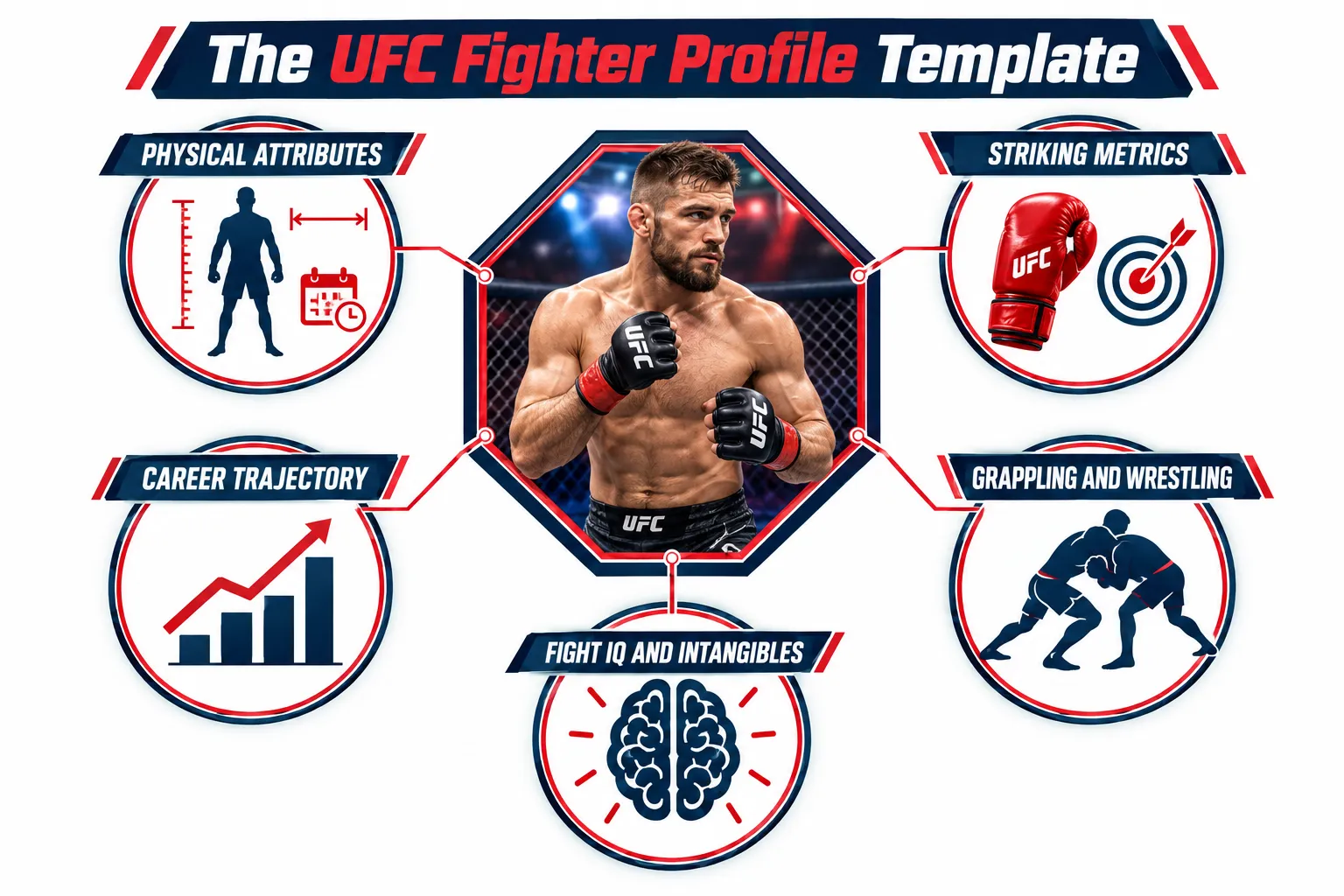
A good profile isn’t a highlight reel. It’s a checklist. Analysts and bettors in 2026 lean on a standardized template that blends hard numbers with context, rather than vibes [2]. Here’s the version worth memorizing.
1. Physical Attributes
Height, reach, age, and weight-class history set the stage. A four-inch reach advantage changes how a fighter can afford to strike from range, while a long title run often means more wear on the body than the record book shows. This is also where size mismatches come in, the same logic BJJ practitioners use when thinking through how to beat bigger opponents in jiu jitsu applies directly to undersized UFC fighters who rely on angles and speed instead of raw mass.
2. Striking Metrics
Pull these from official bout records and derivative data hubs:
- Significant strikes landed per minute (SLpM)
- Striking accuracy
- Striking defense
- Knockdown rate
These numbers tell you whether a fighter wins rounds by volume or by waiting for one clean shot.
3. Grappling and Wrestling Metrics
- Takedown accuracy
- Takedown defense
- Control time / top position time
- Submission attempts
Takedown accuracy versus takedown defense is the stat pairing experts flag as the most predictive in the sport, it largely decides whether a fight stays on the feet or ends up on the canvas [1]. Modern analysis also looks past the single shot, focusing instead on chain-wrestling and scramble ability, since fighters who layer multiple setups and strike their way into entries outperform those who rely on one isolated takedown attempt [4].
4. Fight IQ and Intangibles
Durability, recovery between rounds, cage awareness, and composure under pressure don’t show up in a box score, but they decide championship fights. This is the “feel” category, the thing a coach notices in the corner that a spreadsheet misses.
5. Career Trajectory and Milestones
Look at title shots, win streaks, opponent quality, and recent form rather than career win totals alone. A 15-3 record against soft competition tells you far less than a 9-2 record built against ranked contenders.
| Profile Pillar | What to Check | Why It Matters |
|---|---|---|
| Physical | Height, reach, age | Sets range and pace limits |
| Striking | SLpM, accuracy, defense | Shows output and risk |
| Grappling | TD accuracy/defense, control time | Predicts where the fight happens [1] |
| Fight IQ | Durability, composure | Separates good fighters from champions |
| Trajectory | Last 3 fights, strength of schedule | Shows real current form, not past glory |
Style Archetypes Every Analyst Should Know
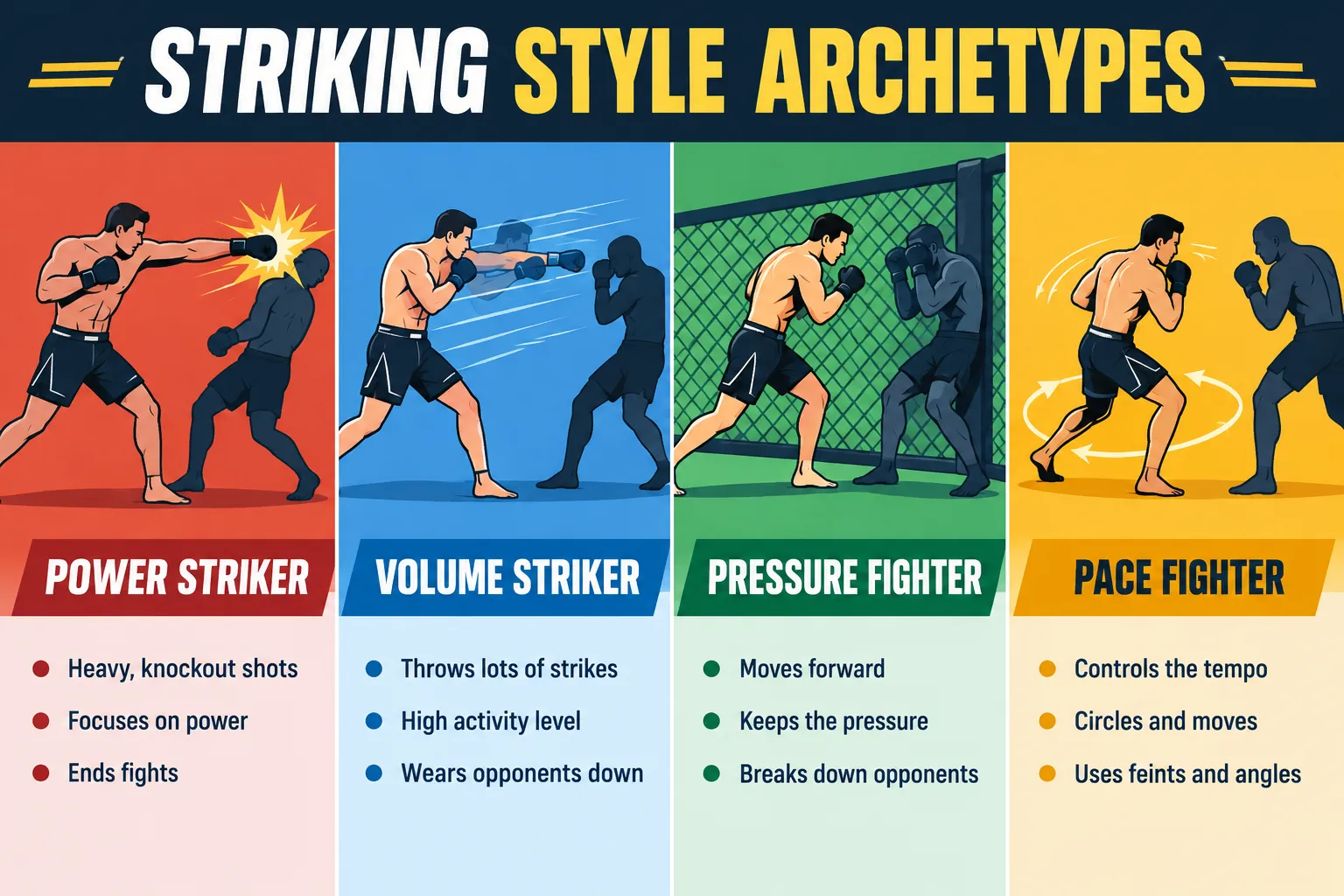
Striking analysts now sort fighters into five broad archetypes, each with distinct output and risk profiles [2][3][4]:
- Power Strikers, Lower volume, higher knockout potential. They trade activity for one-shot finishing power.
- Volume Strikers, Win rounds through sustained output and combinations, a style rewarded heavily in 2025-2026 title fights [2].
- Pressure Fighters, Win through forward movement, cage cutting, and clinch entries, but tend to absorb more damage and show lower accuracy across five rounds [3][4].
- Pace Fighters, Lean on feints, layered combinations, and disciplined defense; sustaining pace into late rounds is now considered a stronger predictor of long-term success than raw knockout power [3].
- Counter-Strikers, Wait, read, and punish mistakes rather than initiate.
Grapplers will recognize this instantly. It’s the same split between someone who hunts a guard pass every ten seconds versus someone who plays a patient, top-pressure game and waits for the scramble to open up. If you’ve ever compared a 10th Planet black belt to a traditional black belt, you already understand that style differences aren’t about who’s “better”, they’re about different risk tolerances producing different results.
Case Study: Reading a Fighter’s Career Numbers
Numbers only mean something when you apply them to a real case. Take flyweight contender Joshua Van. His profile shows an average fight time of 14:14, 2.85 rounds per fight, a fight completion rate of 81.3%, and 41.7% of his bouts ending inside the distance [6]. Combined with a strength-of-schedule metric capturing opponent quality, that data paints a clear picture: a fighter who finishes a meaningful share of his fights but also goes the distance often enough to show durability and a deep gas tank [6].
This is exactly the kind of profile you should build for any fighter you’re studying, not a highlight-reel biography, but a data trail that shows finishing tendencies, typical fight shape, and the level of opposition behind the record.
Common Weaknesses Analysts Flag
Spotting weaknesses is where profiling earns its keep. Recent matchup breakdowns show how experts translate style clashes into practical strengths and weaknesses, labeling one fighter the more technical range striker against an opponent’s aggressive, power-punching approach, or noting that a fighter engages well in grappling exchanges but struggles to find offense on the feet [8]. These same evaluations forecast striker-versus-wrestler dynamics, where one side looks to tie up in the clinch specifically to blunt the other’s striking output [8].
Common red flags worth tracking in any profile:
- Thin gas tank past round two, despite a strong start
- One-dimensional takedown entries that stop working once scrambles enter the picture [4]
- Weak submission defense on the ground, something grapplers can spot faster than most commentators by watching hip movement and frame positioning
- Reliance on a single power shot with no backup plan if it’s not landing
This is also where crossover events matter. Watching how a dominant grappler fares against a dangerous striker, like the recent UFC BJJ 11 results showing Mikey Musumeci clash with Bryce Mitchell, gives you a live lab for testing whether “elite BJJ” actually translates when the gloves and rules change. The same goes for grappling showcases like Andrew Tackett targeting Paddy Pimblett after a dominant UFC BJJ 10 showcase, which exposed exactly how far a pure grappling base can carry a fighter against a striking-first opponent.
Tools That Power Modern UFC Fighter Profiles
You don’t need a stats degree to profile fighters like an analyst anymore. A handful of platforms do the heavy lifting:
- UFC Savant, Combines striking, grappling, pace, control, and finishing ability into a True Skill Rating (TSR) and a Current Competitiveness Rating (CCR), answering both “how good is this fighter” and “how good are they right now” [5].
- Stats Fight, Uses a 0-100 composite score and an AI “virtual judge” system built on more than 100 metrics to score rounds and estimate win probabilities [10].
- MMA Index and similar apps, Offer live strike, accuracy, defense, and control-time breakdowns for on-the-fly scouting during a card [9][10].
These tools matter because they let fans apply the same stepwise process experts recommend: check the odds and implied probabilities, pull both fighters’ stat profiles, review their last three fights for trends rather than results alone, and decide whether the bout is most likely to be contested standing, in the clinch, or on the mat [1][2]. That last question, where does this fight actually happen, is the heart of grappling-aware scouting. It’s the exact mindset you’d bring to studying a side mount battle or planning an escape before it’s needed.
How to Analyze Styles, Strengths, Weaknesses, and Career Paths Step by Step
Put it all together with this five-step workflow:
- Collect the baseline data, height, reach, age, SLpM, accuracy, takedown stats [2].
- Tag the style archetype, power, volume, pressure, pace, or counter-striker [2][3].
- Flag the weaknesses, gas tank, submission defense, one-note takedown entries [4].
- Check recent trajectory, last three fights, not career totals, and the quality of opposition [1][2].
- Synthesize intangibles, durability, composure, and fight IQ into one coherent read, not a single stat in isolation [2].
Grapplers already do a version of this before stepping on the mats with someone new. Think about how you’d size up grip fighting, base, and submission defense before a roll, it’s the same instinct as judging whether a fighter’s grappling profile is built on chain-wrestling versus a single desperate shot. Our breakdowns on topics like Judo or BJJ for a street fight use the same comparative thinking: strip the hype away and look at what actually works under pressure.
Conclusion
Profiling a UFC fighter the right way isn’t about memorizing one stat or chasing a highlight reel, it’s about running the same five-pillar checklist every time: physical attributes, striking, grappling, fight IQ, and career trajectory. Do that consistently, and you’ll spot style clashes, weaknesses, and breakout prospects long before the broadcast commentary catches up.
Next time you’re prepping to watch a card, grab a notepad, pull up the fighters’ last three outings, and run them through the template above before the first bell. Then come back and check it against how the fight actually plays out, that’s where you’ll sharpen your own scouting eye fastest.
Oss!
References
[1] Ufc Fighter Analysis For Betting – https://betmmafight.com/articles/ufc-fighter-analysis-for-betting/ [2] How To Analyze Ufc Fighters – https://ufcbettinghub.com/articles/how-to-analyze-ufc-fighters/ [3] Pressure Fighters Vs Pace Fighters Which Style Wins More Often In The Ufc – https://combatpress.com/2026/07/pressure-fighters-vs-pace-fighters-which-style-wins-more-often-in-the-ufc/ [4] Ufc Fight Night 271 Breakdown Key Fights Odds Insights – https://www.betnow.eu/ufc/ufc-fight-night-271-breakdown-key-fights-odds-insights/ [5] ufcsavant – https://ufcsavant.com/ [6] Joshua Van – https://fightingdata.com/fighters/joshua-van/ [8] sportsline – https://www.sportsline.com/ufc/ [9] Mmaindexcom – https://x.com/MMAIndexCom [10] Details – https://play.google.com/store/apps/details?id=com.mmafantasyrncli&hl=en_US