A boxing judge scores a round using four criteria. A UFC judge scores that same three minutes, or five, in the cage, using three completely different ones. That one gap in the rulebooks explains more scorecard controversy than any conspiracy theory ever could, and it’s the first clue that these two combat sports are not just cousins wearing different gloves.
Here at Jiujitsu Central, we live on the mats, but we know plenty of grapplers who also throw hands at the boxing gym or test their guard passing inside the cage. Understanding UFC vs Boxing: Rules, Training Demands, Scoring, and Which Sport Fits You matters whether you’re picking your first combat sport, cross-training for MMA, or just settling a debate at the academy. Let’s roll into the heart of it.
Key Takeaways
- Legal techniques differ massively: boxing allows only gloved punches above the belt, while UFC/MMA permits strikes, clinch work, takedowns, and submissions.[4][5]
- Scoring criteria diverge: boxing judges weigh clean punching, effective aggression, ring generalship, and defense, while MMA judges prioritize effective striking/grappling, aggression, and cage control.[4][8]
- Both use the 10-point-must system, but World Boxing rules now require a declared winner every round, eliminating 10-10 scores.[3][7]
- Training demands split sharply: boxers specialize in punching and footwork; MMA athletes must split time between striking, wrestling, and submission grappling.
- Success doesn’t transfer automatically, a boxer’s hands won’t save them from a takedown, and a grappler’s guard won’t help if they can’t check a leg kick.
The Core Rule Differences Between UFC and Boxing
Start here, because everything else, training, scoring, even your stance, flows from what’s actually legal. Boxing is beautifully narrow: gloved punches, thrown with the knuckle part of the glove, landing on the front or side of the head or body above the belt. The British Boxing Board of Control spells this out as the entire foundation of “attack” in its rulebook, and it hasn’t changed much in a century for good reason, it works.[5]
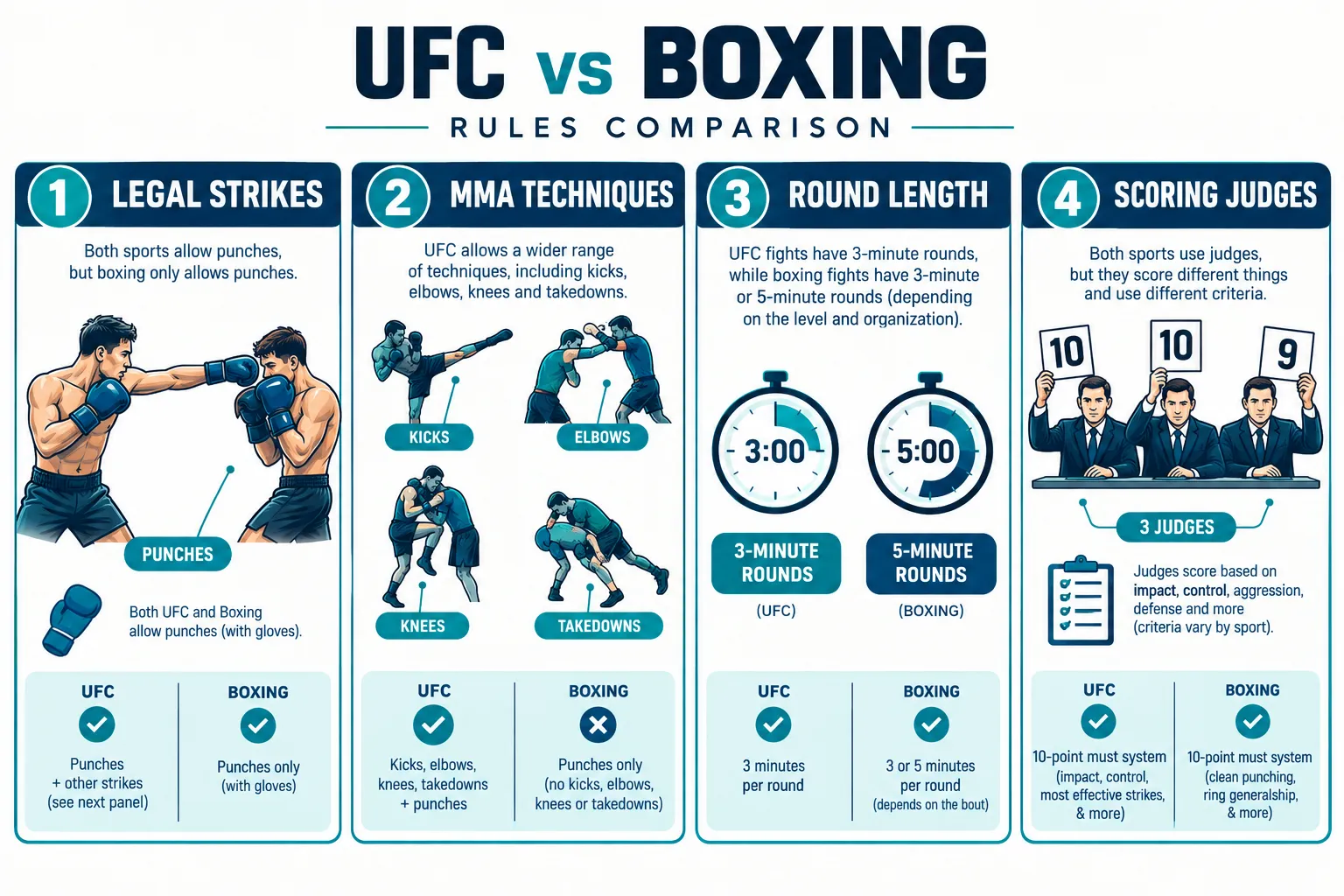
The Unified Rules of Mixed Martial Arts, which govern UFC bouts, open the toolbox much wider. Fighters can throw punches, kicks, knees, and elbows, work from the clinch, shoot takedowns, and finish with submissions, all inside one framework, with a long list of fouls (eye pokes, groin strikes, strikes to the back of the head) spelled out in detail.[4]
| Factor | Boxing | UFC / MMA |
|---|---|---|
| Legal strikes | Punches only, above the belt | Punches, kicks, knees, elbows |
| Grappling | None allowed | Clinch, takedowns, submissions |
| Round length | 3 minutes (men), often 2 minutes (women) | 5 minutes |
| Title fight rounds | 12 rounds (men), 10 (women) | 5 rounds (championship) or 3 |
| Ring/cage | Roped ring | Fenced octagon |
That extra legal real estate is exactly why grapplers who read our breakdown of how to fight a bigger and stronger opponent often find MMA’s rule set more forgiving, a smaller fighter with a sharp double-leg has options a boxer simply doesn’t get.
UFC vs Boxing Scoring: How Judges Actually See the Fight
This is where most casual fans get surprised. Both sports use a 10-point-must system, the round winner gets 10, the loser gets 9 or fewer, with point deductions for knockdowns or fouls.[4][6] But “winning the round” means something different depending on which sport you’re watching.
Boxing’s ringside judges look at four things, in this rough order of importance:
- Clean punching, scoring blows landed with the knuckle part of the glove
- Effective aggression, pressure that actually lands, not just forward motion
- Ring generalship, who’s dictating where the fight happens
- Defense, avoiding punishment while still working
A men’s world title fight runs 12 rounds (120 points max); a women’s title fight typically runs 10 rounds (100 points max), with outcomes falling into unanimous, split, or majority decisions, or a draw.[6][8] The Association of Boxing Commissions’ judge manual reinforces that judges score round by round, partial rounds only kick in once four full rounds are complete, and nobody gets to touch a scorecard after the bell.[1][9] World Boxing’s updated rules go a step further, ranking scoring blows first, technical/tactical superiority second, and overall competitiveness third, and critically, requiring a winner every round, with no 10-10 scores allowed.[3][7]
“A punch that lands clean in boxing can win you a round outright. The same punch in MMA might just be one ingredient in a much bigger recipe.”
UFC judges, by contrast, work from the Unified Rules of MMA, prioritizing effective striking and grappling first, effective aggressiveness second, and control of the fighting area last.[4] Notice what’s missing compared to boxing: there’s no standalone “defense” category, and a takedown or a dominant top position can win a round even if almost no strikes land. That’s part of why BJJ fans tend to appreciate MMA scoring, it actually credits what happens on the mat, not just what happens standing up. There’s also growing industry conversation, heading into the ABC’s 2025 rules discussions, about simplifying MMA criteria into “damage, dominance, and duration” to cut down on controversial decisions.
Training Demands: Why a Great Boxer Isn’t Automatically a Great UFC Fighter
Ask any coach who’s trained both disciplines, and they’ll tell you the same thing: boxing and MMA build different bodies and different brains. Boxers specialize relentlessly, high-volume punch combinations, defensive head movement, footwork drilled for hours, and conditioning tuned to explosive three-minute bursts with a one-minute rest. Everything in the gym serves one goal: landing clean and not getting hit back.
MMA athletes don’t get that luxury of specialization. A UFC training camp has to budget time across striking (often multiple disciplines, boxing, Muay Thai, kickboxing), wrestling for takedowns and takedown defense, and jiu-jitsu for submissions and ground control, all while conditioning for five-minute rounds that can swing from standing exchanges to clinch work to a full guard battle in seconds. If you’ve ever compared injury patterns between grappling-heavy and striking-heavy training, our piece on BJJ vs Muay Thai injuries shows just how differently these training loads stress the body, and MMA athletes absorb a version of almost all of it.
This is also why the UFC’s push into grappling-specific content, like the UFC’s groundbreaking live BJJ series, makes sense from a talent-development standpoint, the organization knows submission skill isn’t optional anymore. The old myth that a heavy-handed boxer could simply “pick up a little wrestling” and compete at the top of MMA died out decades ago, right around the time BJJ pioneers like Helio Gracie proved that technique and ground control could neutralize pure striking power.
Stance, Range, and Defensive Priorities
Stand a boxer and an MMA fighter next to each other and you’ll notice it immediately. A boxer’s stance is built for maximum punching power and head movement, feet closer together, weight loaded to slip and counter. An MMA fighter’s stance has to account for takedowns, so it’s typically a bit wider and more squared, sacrificing some pure punching mechanics for balance and sprawl readiness.
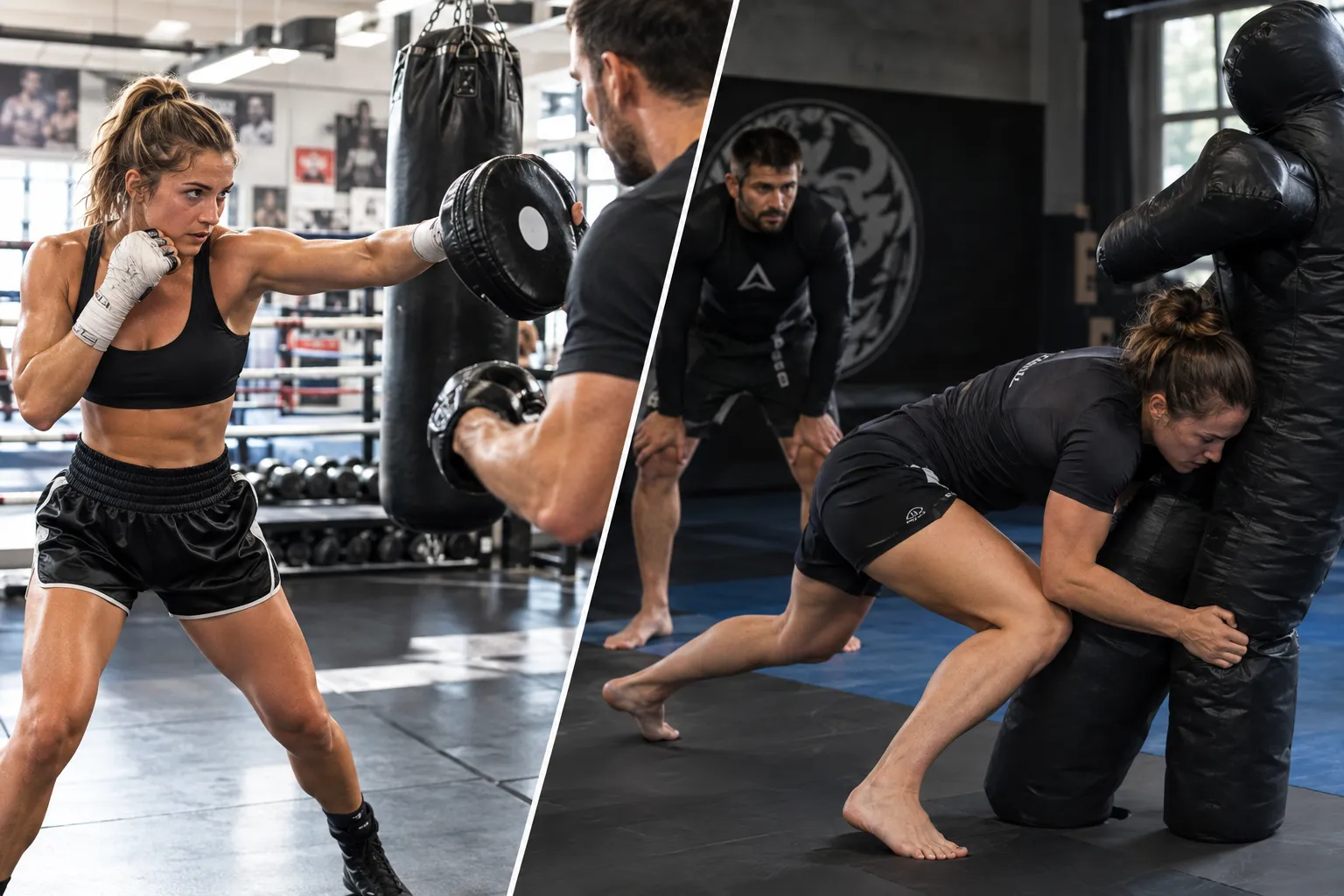
Defensive priorities split the same way:
- Boxers defend almost exclusively against punches, parries, rolls, blocks, pivots
- MMA fighters must defend punches, kicks, knees, elbows, clinch entries, AND takedowns, often in the same exchange
- Range management differs too: boxing range is about inches and angles; MMA range adds kicking distance and a whole “clinch-to-mat” dimension
That extra dimension is exactly why a fighter with strong leg lock awareness or solid side control fundamentals brings something to MMA that a pure boxer simply never has to train for. It’s also why grapplers transitioning into striking-heavy sports sometimes feel exposed on the feet, the footwork patterns just don’t overlap as cleanly as people assume.
Equipment and Safety: Gloves, Padding, and Modern Rule Changes
Equipment tells its own story. Boxing gloves are heavier, typically 8 to 10 ounces for professionals, designed to protect the hand through thousands of punches while still allowing knockout power. MMA gloves are thin, fingerless, and light, sacrificing hand protection so fighters can grip, grapple, and work submissions.
Safety regulation is evolving fast on both sides, but UFC rules have been moving especially quickly through 2025 and 2026. Reporting on the promotion’s recent and anticipated changes points to:
- 🩺 Mid-fight hydration checks to discourage extreme weight cutting
- 🧠 Stricter concussion protocols with enhanced neurological screening
- 🧪 Expanded out-of-competition drug testing
- 🥊 Updated glove padding standards
- 🤖 AI-assisted replay review for faster, fairer officiating
- 📊 Augmented-reality stat overlays for broadcasts[2]
Many of these are still rolling out rather than fully locked in, but the direction is clear: both sports are tightening safety nets around fighters, and testing protocols are a shared concern across combat sports organizations, something covered in our own look at UFC BJJ insights on PED testing ahead of recent events.
Which Sport Fits You? Finding Your Path from the Gym to the Cage or Ring
So, boxing or UFC, which one actually fits you? Honestly, it depends on what you enjoy and what your body is built for.
Boxing might be your lane if you:
- Love the purity of one skill mastered deeply
- Enjoy footwork, timing, and reading an opponent’s hands
- Prefer training that’s intense but narrower in scope
MMA might be your lane if you:
- Already have a grappling base and want to test it against strikers
- Enjoy variety and problem-solving across ranges
- Don’t mind a steeper, multi-discipline learning curve
There’s no shame either way, and plenty of BJJ practitioners test the waters in both. If you’re curious how different grappling backgrounds translate to live competition, our comparison of a 10th Planet black belt vs a traditional black belt is a good next read, it shows how even within one art, pathways and emphases vary wildly, which mirrors the bigger boxing-versus-MMA decision you’re weighing now.
The honest truth is that success in one sport doesn’t guarantee anything in the other. A world-class boxer’s chin and hands won’t stop a takedown. A black belt’s guard won’t matter if a leg kick has already chopped them down before the fight hits the mat. Respect both crafts, and pick the one that matches your goals, your body, and your love of the grind.
Conclusion
Comparing UFC vs Boxing: Rules, Training Demands, Scoring, and Which Sport Fits You really comes down to one idea: these are two deep, demanding crafts that share a scoring framework but almost nothing else. Boxing rewards focused mastery of the punch. MMA rewards versatility across striking, wrestling, and submissions, the same skills many of us have spent years building on the mats.
If you’re a grappler weighing whether to add striking to your game, start slow, find a coach who respects both disciplines, and be honest about what you’re training for, sport, self-defense, or just the love of the grind. Come back and check it with us as this comparison keeps evolving with new rules and new rising stars.
Oss!
References
[1] Abc Boxing Judge Manual 2024 – https://www.abcboxing.com/wp-content/uploads/2024/09/abc-boxing-judge-manual-2024.pdf [2] Ufc 2025 – https://www.hitpaw.com.br/top-trending-tips/ufc-2025.html [3] Summary Of Competition Rule Changes 2024 1 – https://worldboxing.org/wp-content/uploads/2024/10/Summary-of-Competition-Rule-Changes-2024-1.pdf [4] Unified Mma Rules Rev July 2024 – https://www.abcboxing.com/wp-content/uploads/2024/07/unified-mma-rules-rev-july-2024.pdf [5] Rules And Regulations 2024 – https://bbbofc.com/build/documents/Rules_and_Regulations_2024.pdf [6] Cn7x1e827p6o – https://www.bbc.com/sport/boxing/articles/cn7x1e827p6o [7] World Boxing Competition Rules Feb 2024 V3.99 Clean – https://worldboxing.org/wp-content/uploads/2024/03/World-Boxing-Competition-Rules-Feb-2024-v3.99-ClEAN.pdf [8] Boxing Rules And Scoring Explained The Complete Guide – https://www.boxinginsider.com/almanac/boxing-rules-and-scoring-explained-the-complete-guide/ [9] Abc Boxing Judge Manual – https://www.abcboxing.com/wp-content/uploads/2025/10/ABC-BOXING-JUDGE-MANUAL.pdf [10] Bkf Unified Rules Rev Jul 2024 – https://www.abcboxing.com/wp-content/uploads/2024/07/bkf-unified-rules-rev-jul-2024.pdf