Submissions end roughly 17% of UFC fights, and almost all of them trace back to Brazilian Jiu-Jitsu’s ground game. That single stat tells you a lot about why this debate matters. But it doesn’t tell the whole story, because the moment a fight hits the cage fence or the clinch, judo starts pulling its own weight in ways BJJ simply wasn’t built to do.
So when people ask about Brazilian Jiu-Jitsu vs Judo for MMA: Which Art Builds Better Takedowns, Control, and Submissions?, the honest answer isn’t “pick one.” It’s that each art wins a different phase of the fight. This piece breaks it down phase by phase, grip fighting, throws, trips, pins, guard work, and submissions, so you can see exactly where each style shines inside a cage, not just on a mat.
Key Takeaways
- Judo generally wins the standing clinch phase for MMA takedowns, but it’s less efficient than wrestling for shot-style entries [1].
- BJJ dominates the ground phase, offering deeper submission chains and positional control that match MMA’s scramble-heavy ruleset [2].
- Submissions in MMA are overwhelmingly BJJ-based, accounting for about 17% of UFC finishes.
- Judo controls where the fight happens; BJJ controls what happens once it gets there [3].
- Hybrid grappling, judo entries plus BJJ ground systems, is the direction modern coaching is trending [4].
Cage Transfer: Why the Fence Changes Everything
The first thing both arts have to answer for in MMA isn’t technique, it’s geography. Judo was built around a flat mat with no walls, and BJJ competition rules were built around a mat too. MMA adds a cage fence, and that fence rewrites the standing game entirely.
Judo throws rely on off-balancing an opponent across open space. In a cage, fighters can post against the fence and kill a throw’s momentum before it finishes. That’s part of why pure judo specialists are relatively rare in MMA compared to BJJ- or wrestling-based fighters, the art transfers well in spirit, but needs real adaptation to work against the fence [2][5].
BJJ, by contrast, transfers almost seamlessly once the fight is on the ground, because IBJJF-style positional hierarchy (mount, back control, side control) maps directly onto how MMA ground fights actually unfold. For a deeper look at how BJJ holds up, and where it doesn’t, once strikes enter the picture, check out our breakdown of what Brazilian Jiu-Jitsu can and cannot do in a real fight.
Grip Fighting: The Quiet Battle Before the Throw
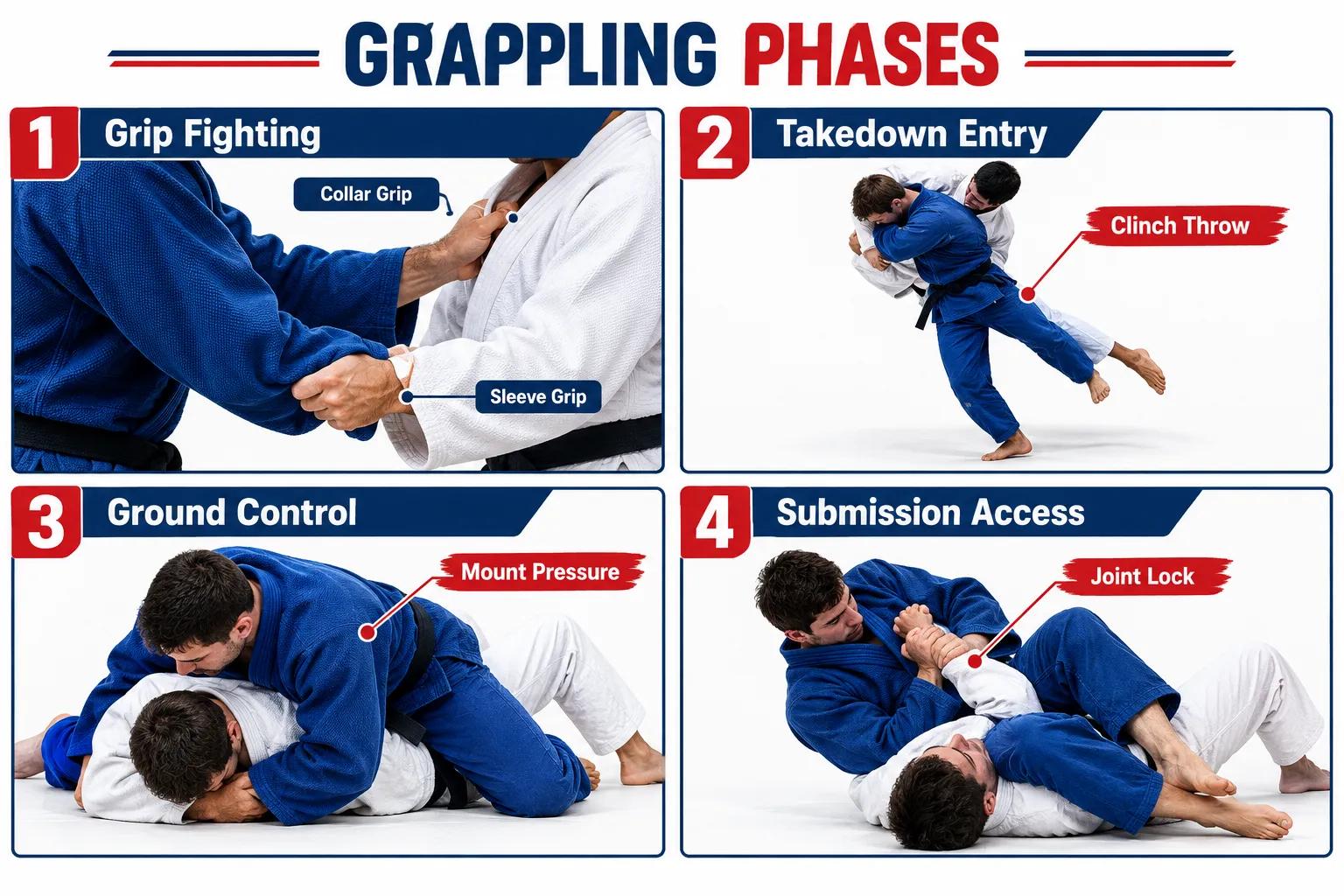
Before any throw or takedown happens, there’s a grip fight, and this is where judo’s background really shows up. Judo players spend thousands of hours fighting for sleeve and collar control, fighting hand-fighting sequences that most BJJ practitioners simply don’t drill with the same intensity, since a lot of modern no-gi BJJ skips grips almost entirely.
In MMA, where fighters often wear no gi, this translates into underhooks, collar ties, and wrist control rather than classic judo grips. Judo players adapt their grip instincts well here because the principle, control the limb before you control the body, carries over even without fabric to grab.
Standing Phase: Where Judo Builds Better Takedowns
This is judo’s strongest argument in the Brazilian Jiu-Jitsu vs Judo for MMA conversation. Judo is widely rated as the superior art for MMA takedowns from the clinch, thanks to its deep catalog of hip throws, foot sweeps, and trips [1][5]. A well-timed o-soto-gari or uchi-mata can put a fighter on the canvas instantly, often with enough impact to set up a follow-up strike.
That said, judo isn’t the whole takedown picture in modern MMA. Data on UFC takedown types shows wrestling-style shots, level changes and double legs, dominate over pure judo throws numerically [3][5]. Judo shines specifically in clinch range; it’s less built for shooting in from distance.
Judo’s standing advantages:
- 🥋 Explosive hip and shoulder throws (seoi-nage, harai-goshi)
- 🥋 Excellent foot sweeps for off-balancing
- 🥋 Strong clinch entries from collar ties
- 🥋 Fast learning curve for basic throw mechanics compared to deep BJJ submission chains [4]
Judo’s standing limitations:
- ⚠️ Weaker against shot-style wrestling entries
- ⚠️ Cage fence disrupts classic off-balancing lines
- ⚠️ Fewer specialists reach elite MMA level compared to wrestling or BJJ bases
If you’re curious how a grappler with a purely judo background actually measures up against BJJ experience belt-for-belt, our piece on BJJ purple belt vs judo black belt digs into that exact matchup.
Pins and Trips: Control Before the Ground Fight Even Starts
Judo’s osaekomi (pinning) rules reward holding an opponent down, which sounds like BJJ’s job, but judo pins are time-limited and designed to end a match, not to set up submissions. In MMA, that pinning instinct is useful for a few seconds of ground-and-pound control, but it rarely evolves into the layered submission hunting that defines BJJ.
Trips and sweeps from judo also serve a dual purpose in MMA: they change where the fight happens (standing to ground) and briefly control the opponent’s balance mid-transition. This is the clearest illustration of the idea that judo controls where a fight happens, while BJJ controls what happens once it’s there [3].
Ground Phase: Why Brazilian Jiu-Jitsu for MMA Wins Control and Submissions
Here’s where the gap widens. BJJ is regarded as the most complete grappling art for MMA ground control and submissions, and its rule set mirrors live ground dynamics, scrambles, strikes, cage grabs, far more closely than judo’s ne-waza (ground phase), which is heavily time-restricted in competition [2][3].
A BJJ-based fighter brings:
- Guard retention that slows an opponent’s ground-and-pound and buys time to work
- Positional hierarchy (mount → back control → submission) that’s second nature after years of live rolling
- A deep submission toolkit, chokes, armbars, leglocks, that modern grappling trends keep expanding, as covered in our look at ADCC-era grappling trends and the decline of pure guard players
- Submission chains, stringing together attacks rather than hunting one isolated finish
This is also why submissions remain overwhelmingly BJJ-based in modern MMA. Early UFC history proved this concept directly: fighters with no answer for mount or back control got submitted again and again, cementing BJJ as the sport’s default submission base [2][5].
Submission Access: The Real Separator
“Judo’s main contribution is control over where the fight happens. BJJ’s main contribution is control over what happens once it hits the ground.” [3]
That quote sums up the entire debate. Judo does have its own submission tradition (judo includes armbars and chokes historically), but competition rules sharply limit ne-waza time, so judo players rarely develop the same depth of submission setups, scrambles, and chain-wrestling-to-submission instincts that BJJ black belts build over a decade of live rolling.
Recent expert rankings still place BJJ above judo for overall MMA effectiveness specifically because of this submission and control toolkit [2]. Cross-style coaching guides now frame BJJ explicitly as the foundational grappling base for MMA, with judo treated as a complementary source of takedowns rather than a standalone system [2][5].
Training Timeline: Which Art Pays Off Faster?
If you’re a coach or a competitor mapping out a training cycle, timing matters. Judo tends to produce usable takedown proficiency sooner, the throw mechanics, once grooved, translate quickly into live sparring [4]. BJJ’s payoff curve is slower but deeper: positional control and submission chains take years to mature, but they keep expanding long after a judo throw has plateaued [4].
| Factor | Judo | Brazilian Jiu-Jitsu |
|---|---|---|
| Time to competency | Faster for basic throws | Slower, deeper over years |
| Best phase | Clinch / standing | Ground / submissions |
| Submission depth | Limited (rule restrictions) | Extensive, chain-based |
| MMA transfer | Needs fence adaptation | Transfers directly |
Forward-looking coaching trends increasingly favor a hybrid model, judo entries paired with BJJ ground systems, rather than fighters choosing one art exclusively [4]. If you want to see how coaches actually break down a fighter’s full grappling package on film, our guide to analyzing a fighter’s striking, wrestling, and grappling game is a solid next stop.
Which Art Should You Train for MMA?
If you’re asking Brazilian Jiu-Jitsu vs Judo for MMA: Which Art Builds Better Takedowns, Control, and Submissions? for your own training plan, the honest answer depends on your goals:
- Want faster standing offense and clinch control? Lean judo.
- Want a deep, evolving ground game with real submission threat? Lean BJJ.
- Want to actually compete at a high level? Train both, most elite MMA grapplers blend wrestling, judo entries, and BJJ ground systems rather than staying loyal to one discipline [4].
If judo isn’t available near you, plenty of BJJ academies teach judo-influenced takedowns as part of their curriculum, and building a home mat space is a great way to drill both, our guide to jiu-jitsu mats for your garage can help you set one up.
Conclusion: Two Arts, One Complete Fighter
Neither art “wins” outright, and that’s the honest takeaway here. Judo builds faster, harder takedowns from the clinch. BJJ builds deeper control and the submission game MMA fights are actually finished with. The best fighters, and the smartest grapplers reading this, stop treating it as a rivalry and start treating it as a toolbox.
Come back and check out more breakdowns like this on the mats of Jiujitsu Central, whether you’re chasing your next stripe or just trying to understand what makes a fight tick, we’ve got you. Oss!
References
- Blog Judo vs. Jiu Jitsu From Throws to the Ground. fightencyclopedia.com.
- Blog Bjj vs. Judo Grappling Comparison. fightencyclopedia.com.
- Comparing Combat Effectiveness. gymdesk.com.
- 236 247 Litwiniuk Et Al Arch Budo 2025. archbudo.eu.
- Blog Bjj vs. Judo Grappling Comparison. fightencyclopedia.com.
brazilian jiu-jitsu, judo, mma grappling, takedowns, ground control, submissions, clinch fighting, BJJ vs judo, mma training, grappling comparison, judo throws, cage wrestling