
Open a major sports page this month and there’s a decent chance you’ll find Brazilian Jiu-Jitsu sitting next to football and basketball coverage. Outlets like The New York Times and Cleveland.com have been covering BJJ’s rise not as a niche martial art story, but as a mainstream sports phenomenon worth tracking [1][2]. That’s new. For decades, BJJ lived mostly in the shadows of MMA, known to insiders and the curious few willing to get choked by a stranger on their first night. Not anymore.
The global mainstream surge of Brazilian Jiu-Jitsu and what it means for local academies is no longer a mats-only conversation, it’s showing up in business filings, youth sports budgets, and women’s lifestyle media. For academy owners and everyday practitioners, this surge isn’t just flattering. It’s reshaping how gyms operate, compete, and grow. Let’s roll into what’s actually happening and what it means for the gym down the street from you.
Key Takeaways
- 🌍 Major mainstream media now treats BJJ’s growth as a legitimate sports business story, not a fringe hobby piece [1][2].
- 📈 Industry data shows the martial arts and BJJ-adjacent market expanding steadily, with real revenue and investment implications for academy owners [3][4].
- 👧 Kids’ programs and women’s participation are becoming central growth drivers, not side offerings [5].
- 💻 Latin American academies are leading a wave of digitization and “platformization” of training and membership management [6].
- 🥋 Local academies that professionalize operations and lean into community identity will be best positioned to benefit from this surge.
Why Mainstream Media Is Suddenly Paying Attention
BJJ has quietly built credibility for over three decades, but the tipping point into true mainstream coverage is recent. Reporting from Cleveland.com frames BJJ as a sport “rising in popularity in the US and abroad,” pointing to expanding participation well beyond the traditional MMA crossover crowd [1]. The New York Times’ sports vertical has similarly covered BJJ’s rise as a standalone trend worth national attention [2].
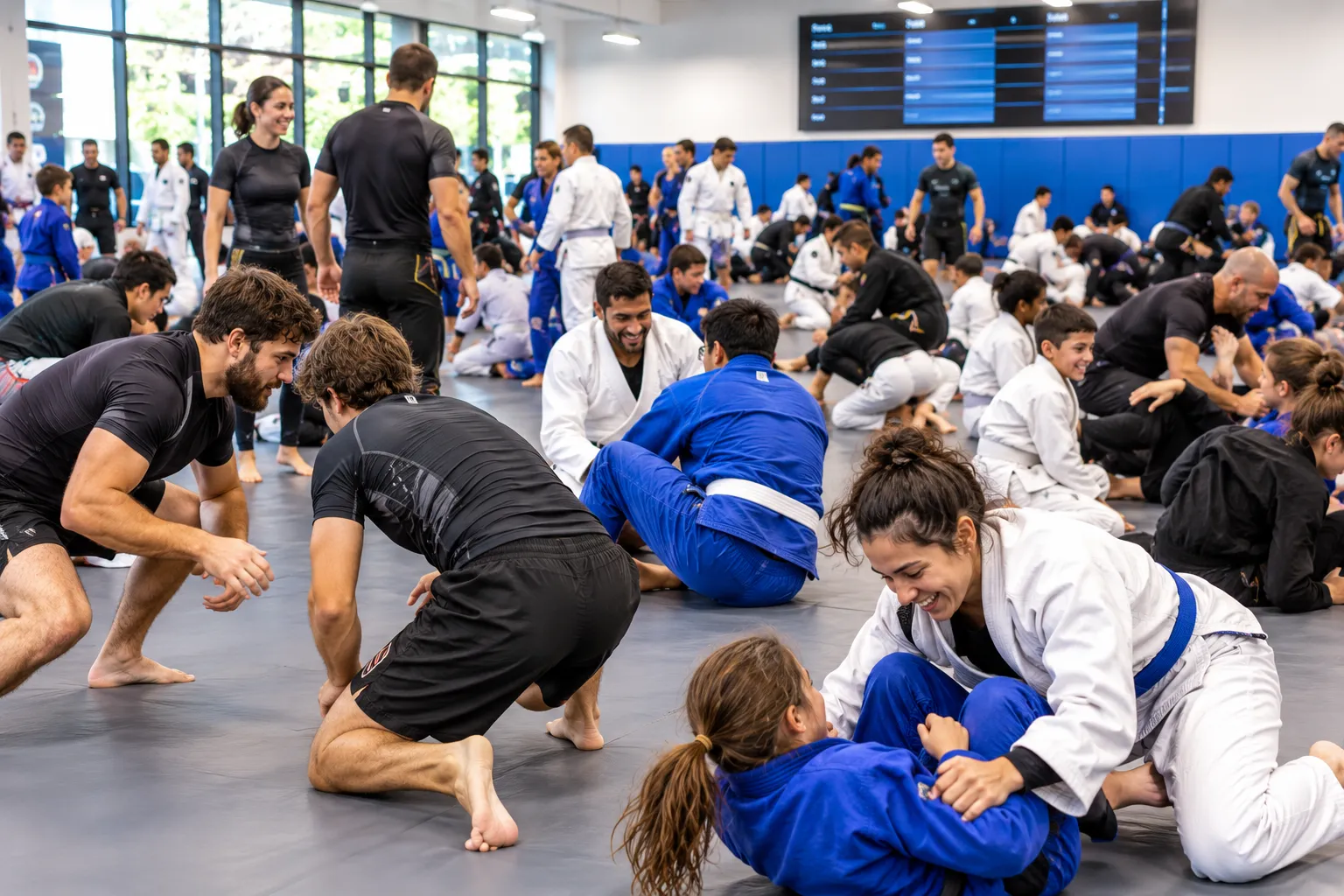
This matters because media attention changes who walks through the academy door. It used to take an MMA fight on TV to spark a wave of new white belts. Now, standalone BJJ content, profiles, competition coverage, lifestyle pieces, is doing that work on its own. If you want a sense of how far the sport’s crossover appeal has stretched, even comparisons between BJJ and other grappling arts, like our breakdown of Dumog vs BJJ, are drawing curious newcomers who’ve never set foot on a mat.
Participation Numbers Behind the Global Mainstream Surge of Brazilian Jiu-Jitsu
Numbers tell the real story behind the headlines. Academic research tracking combat sports participation has documented meaningful year-over-year growth in BJJ practitioner counts across multiple countries [7]. Meanwhile, business-focused coverage of the martial arts industry shows steady expansion in gym counts, membership retention, and ancillary spending like gear and apparel [4].
A few patterns stand out:
- UK and Europe have seen some of the fastest expansion, with new academies opening in cities that had little to no BJJ presence a decade ago.
- North America continues strong, steady growth, fueled by both competition culture and fitness-focused casual members.
- Latin America, BJJ’s historic home, is now exporting not just talent but technology, academy management platforms and digital coaching tools are spreading fast [6].
Competitive infrastructure is scaling right alongside participation. Look at the results pages from major IBJJF events, where divisions keep growing deeper and more internationally diverse [8]. That growth at the top pulls new students in at the bottom, everyone wants to train like the athletes they just watched compete.
The Business Side: Market Growth and What It Means for Local Academies
Here’s where the global mainstream surge of Brazilian Jiu-Jitsu and what it means for local academies gets concrete. This isn’t abstract popularity, it’s translating into real market size. Industry analysis of the martial arts and combat sports business sector points to consistent growth rates and rising investment interest, with gyms increasingly run like structured small businesses rather than passion projects [3][4].
Even corporate filings have started to mention BJJ-adjacent ventures as part of broader fitness and combat sports market narratives, a sign that investors see staying power in the space [6]. For the academy owner teaching six classes a day, that might feel distant from daily life on the mats. But it has real downstream effects:
- Landlords and gym-space developers increasingly see BJJ academies as stable, long-term tenants.
- Gear and apparel brands are investing more in product lines, see the ongoing demand reflected in guides like best-looking BJJ gi options and specialty sizing like gis for big guys.
- Academy owners face more competition for new students, which raises the bar on professionalism, facility quality, and retention strategy.
Kids, Women, and the New Face of the Mats
One of the clearest growth engines behind the mainstream surge is youth programming. Kids’ classes have shifted from a nice side offering to a core revenue pillar for many academies, filling mat space during weekday afternoons when adult classes would otherwise sit empty.
Women’s participation is also reshaping the sport’s public narrative, for better and with some complexity. Lifestyle coverage has examined how BJJ’s physical and competitive culture intersects with body image and self-perception among young women training the art, a conversation the sport is still working through honestly and respectfully [5]. That reporting is a reminder that growth brings new responsibilities: academies welcoming more women and girls need coaching cultures that are genuinely inclusive, not just marketing campaigns that say so.
“The mats don’t care who you are outside the gym, but how we build the room around them matters more than ever.”
For instructors navigating these dynamics, foundational technical content still matters just as much as culture-building. Positional basics like mount top attacks and escaping mount against larger opponents remain the backbone of what keeps new students, of any background, coming back.
Competition, Social Media, and the No-Gi Shift
The competitive calendar has internationalized fast. Talent now moves fluidly between continents for major tournaments, and results from top-tier events show deeper, more global brackets than in years past [8]. That internationalization feeds back into local academies: students want to train the systems they see winning on the big stage.
Social media has amplified a particular shift, no-gi grappling’s rising visibility. Some prominent voices in the community have openly questioned why fans and practitioners increasingly favor no-gi specialists over well-rounded competitors who do both gi and no-gi [9]. It’s a healthy debate, and one that touches every academy’s curriculum decisions: how much mat time goes to gi fundamentals versus no-gi scrambles and leg lock systems.
This is also where athlete profiles and legacy discussions keep the community engaged, fans love debating where legends like Marcelo Garcia, Keenan Cornelius, or Saulo Ribeiro fit into the sport’s evolving no-gi and gi landscape.
Professionalization: What Local Academies Must Do Differently Now
This is the heart of the matter. The global mainstream surge of Brazilian Jiu-Jitsu and what it means for local academies boils down to one word: professionalization. Running a gym on word-of-mouth and a handshake agreement worked when BJJ was a secret handshake society. It doesn’t work in a market where new students compare academies online before ever visiting.
Practical implications for academy owners:
| Old Approach | What Mainstream Growth Demands Now |
|---|---|
| Walk-in sign-ups, cash only | Digital membership platforms and online scheduling |
| One generalist instructor | Specialized coaches for kids, competition, fundamentals |
| Word-of-mouth marketing | Active social media and community content |
| Gi-only curriculum | Balanced gi and no-gi programming |
| Informal belt tracking | Structured promotion criteria and testing standards |
Differentiation matters too. With more academies competing for the same growing pool of students, gyms need a clear identity, whether that’s a strong competition team, a welcoming beginner-first culture, or deep roots in a particular lineage. Understanding your academy’s history and where it sits within the broader Jiu-Jitsu family tree, from Carlos Gracie’s foundational teachings to Rickson Gracie’s philosophy on the art, can actually be a competitive advantage, not just trivia.
BJJ as Lifestyle: Beyond the Mats
Part of what’s fueling mainstream adoption is BJJ’s positioning as more than exercise. It’s increasingly framed as a mental health tool, a stress outlet, and an identity, not just a workout. That framing shows up in everything from recovery routines to nutrition habits practitioners build around training, whether that’s high-protein lunch ideas for busy training days or smarter breakfast choices before an early morning class.
This lifestyle angle matters for retention. Students who see BJJ as part of their identity, not just a hobby they might quit, stay longer, spend more on gear, and bring friends. That’s good for the sport, and good for the business of running an academy.
Forecasts: What to Expect Over the Next 5-10 Years (Predictions)
These are reasoned projections based on current trends, not guaranteed outcomes:
- Continued market expansion is likely, with steady growth in academy counts across Europe and Asia-Pacific regions following the current trajectory [4].
- Deeper professionalization should become standard, with more academies adopting management software and structured business practices.
- No-gi programming will likely keep growing in share relative to traditional gi classes, though gi culture isn’t going anywhere.
- Women’s and youth divisions are expected to keep expanding as core revenue and participation segments.
- Consolidation may emerge in some markets, with stronger academy brands and affiliations outcompeting smaller independent gyms that don’t adapt.
Conclusion
The surge is real, and it’s not slowing down. Mainstream coverage, growing competition fields, booming youth programs, and a maturing business landscape all point in the same direction: Brazilian Jiu-Jitsu has moved from niche to notable. For local academies, the opportunity is significant, but so is the pressure to professionalize, differentiate, and build a genuine community rather than just chase trend-driven sign-ups.
If you run a gym, now’s the time to audit your programs, lean into what makes your academy distinct, and invest in the next generation of practitioners walking through your door. If you’re a student, there’s never been a better moment to deepen your own journey on the mats. Come back and check it, we’ll keep tracking this story as it unfolds. Oss!
References
- This Sport Rising in Popularity in US and Abroad. cleveland.com.
- Brazilian Jiu Jitsu Rise. nytimes.com.
- Bjj and Mma Gym Business the Complete Guide for Academy Owners. fitbudd.com.
- Martial Arts Industry Statistics. gymdesk.com.
- Young Women Brazilian Jiu Jitsu Body Dysmorphia. editors.dazeddigital.com.
- Ex99 1. sec.gov.
- 2411 5142. mdpi.com.
- Results. ibjjf.com.
- Drysdale Questions Why Community Favors Jiu Jitsu Guys Who Only Do Nogi Over Those Who Do Both. bjjdoc.com.