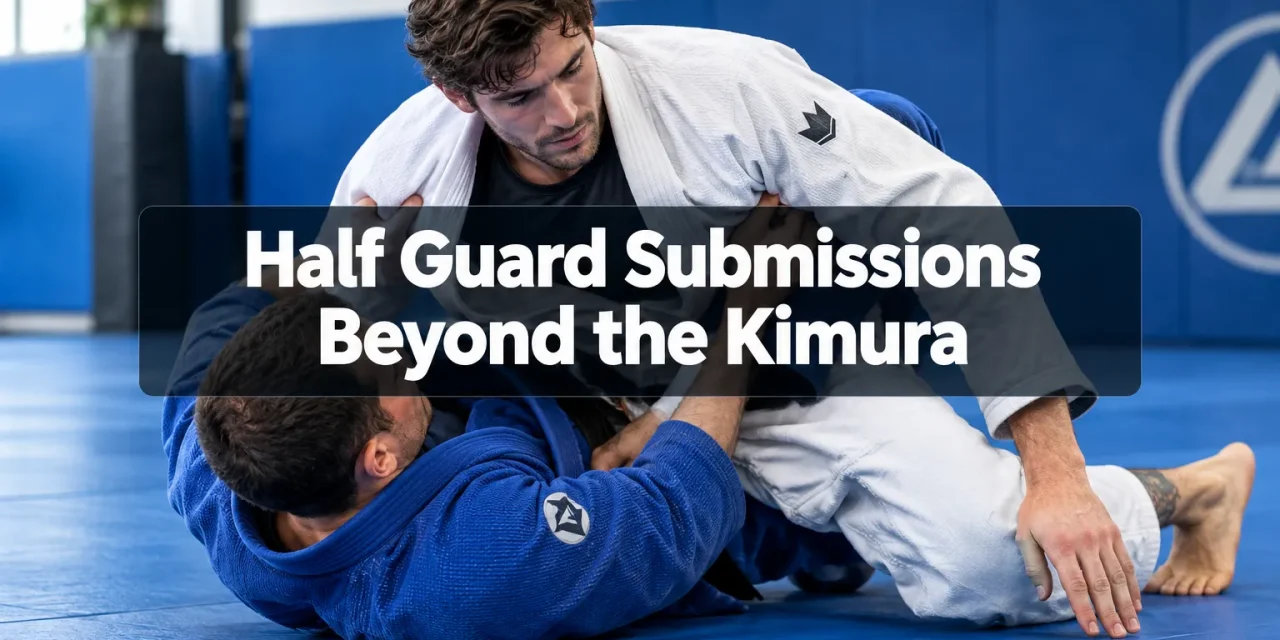
Most white belts learn one submission from half guard: the kimura. It’s a great finish, but it’s also a trap, hunt for it in isolation and sharp opponents will simply stack, flatten, or roll out of range. The real evolution in modern half guard, as seen across 2026’s biggest instructional releases, is that half guard submissions beyond the kimura, knee bars, back takes, and upper-body finishes, are no longer separate tricks. They’re built into the same frames you already use to sweep: the underhook, the knee shield, deep half, and the shoulder crunch. Learn to read your opponent’s posture, and the finish you need is usually already sitting in your hands.
Key Takeaways
- 🔑 Half guard submissions beyond the kimura come from the same control points you use to sweep, the underhook, deep half, and shoulder crunch, not from separate setups.
- 🦵 Knee bars from deep half are now treated as a core half-guard weapon, with structured leg isolation and hip-elevation mechanics layered onto standard half guard control.[4]
- 🔄 Modern deep-half systems are increasingly back-take first, sweep second, using waiter sweeps and crotch-lock entries that flow straight into the seatbelt.
- 💪 The kimura grip itself functions as a control hub, it can lock the arm, power a pass, or convert directly into a back take without ever losing the grip.[10]
- 🧠 Submission threats from half guard aren’t just finishes, they make your sweeps and back takes more effective because they force defensive reactions that open the door elsewhere.[6]
Reading Posture: The Real Key to Half Guard Submissions Beyond the Kimura
Here’s the shift that separates a blue belt grinding for a kimura and a competitor who looks like they have three attacks loaded at once: they’re not reacting to a position, they’re reacting to posture. Every half guard exchange boils down to three opponent states, flat and heavy, posting up to escape, or rolling/scrambling, and each one opens a different door.
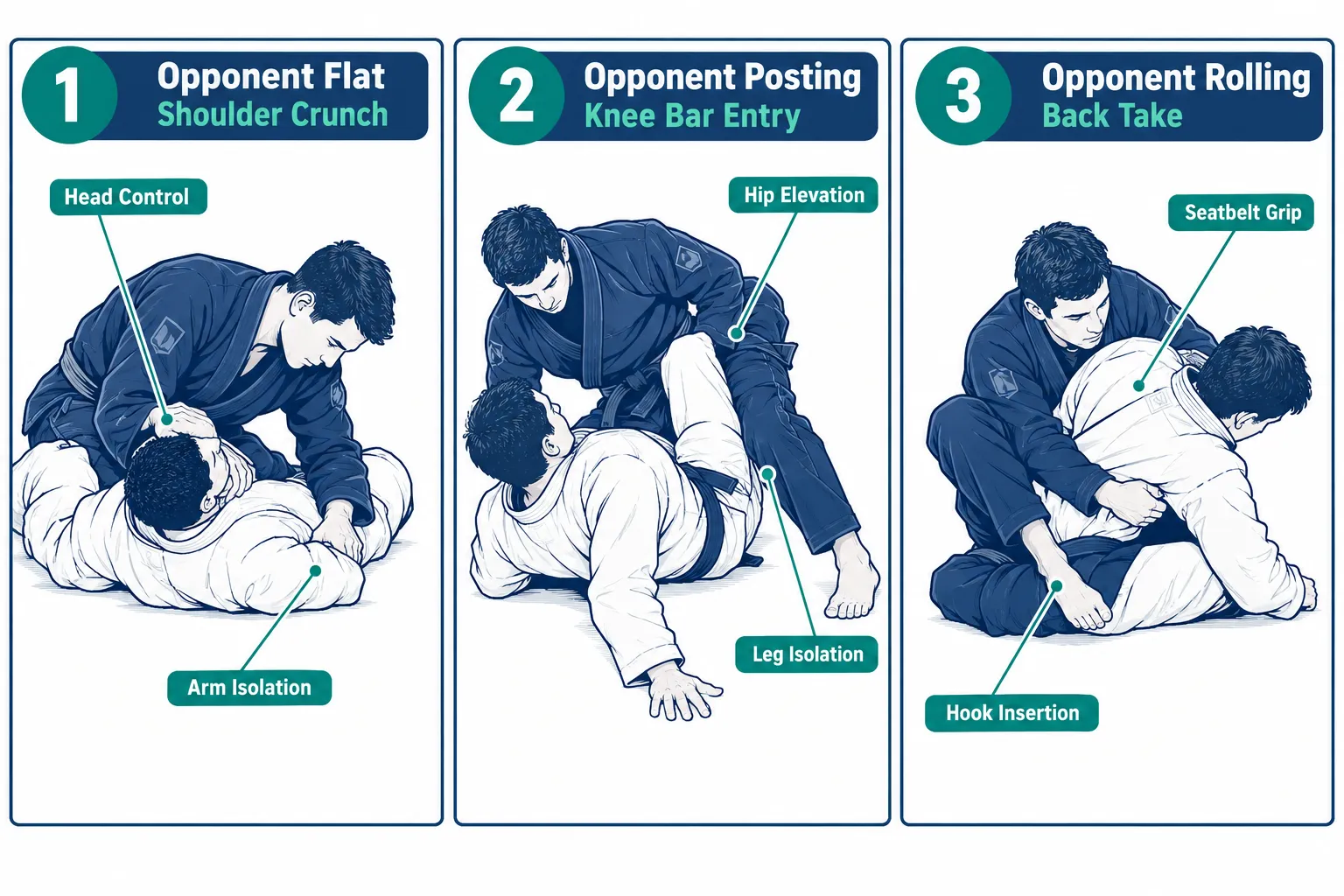
| Opponent Posture | Underhook Status | Primary Attack | Backup Option |
|---|---|---|---|
| Flat, head down | You have the underhook | Shoulder crunch upper-body finish | Kimura or sweep |
| Posting, hips light | Underhook contested | Knee bar from deep half | Waiter sweep |
| Rolling/scrambling | Underhook climbing their back | Back take, seatbelt | Rear-naked choke setup |
This table isn’t academic, it’s the engine behind nearly every modern half guard curriculum, from free camp content to commercial release.[1][2][9] Instead of hunting one submission, you’re reading the body in front of you and picking the branch that’s already open.
Flat Opponent, Underhook Secured: Shoulder Crunch to Upper-Body Finishes
When your opponent collapses their weight forward and you’ve got a deep underhook, you’re sitting in what’s often called shoulder-crunch half guard. This is pure head-and-shoulder control, and it’s a hub position, not just a stalling spot. Camp-level instruction built around this frame shows it converting directly into both upper-body submissions and sweeps, because the same grip that locks the opponent’s posture down also sets up chokes and arm attacks without needing to switch control entirely.[1][5][9]
A clean example: as the opponent wrestles back up to escape the crunch and you feel your underhook slipping, you don’t panic and scramble for guard recovery. Instead, you can bypass the whizzer entirely, thread your free arm through for a choking grip, and finish by rolling over the shoulder, a direct submission answer to the exact moment most grapplers default to a defensive reset. This kind of upper-body choke from half guard treats the “losing the underhook” moment as an attack trigger, not a crisis.
If you’re still working on the fundamentals of staying safe and controlled in these exchanges, it’s worth revisiting half guard bottom defense before layering in finishes, control comes before the choke, every time.
Opponent Posting or Basing: Knee Bars From Deep Half Guard
Once an opponent starts posting their hips back and fighting to free their trapped leg, most white belts think “sweep or die.” But that posting action is exactly when a leg is most exposed. Deep half guard, the position where you’re underneath, controlling one of your opponent’s legs between your own, has quietly become a launchpad for leg attacks rather than just a sweeping tool.
Modern breakdowns of the knee bar from half guard formalize this with a few repeatable details:
- Strict control of the target leg before you ever attempt the extension, no isolation, no attack.
- Hip elevation, driving your hips up and in to take the slack out of the knee joint.
- Linear knee extension, finishing like a straight ankle lock rather than wrenching sideways.
- Maintained body connection, so you’re never fully disconnected and exposed to a scramble.
These mechanics echo straight-ankle-lock fundamentals, layered directly onto the half-guard frame instead of abandoning it for a leg-lock-specific entry. Flagship 2026 reference material has made the same point by cataloging a knee bar straight out of deep half as a structural part of a complete bottom game, right alongside sweeps and back takes, not as a side quest.[4]
“A knee bar from deep half isn’t a gimmick, it’s what happens when the leg you’re already gripping has nowhere else to go.”
If leg entanglements make you nervous, build comfort gradually by drilling the positions where you’re most exposed; our guide to guard bottom defense is a solid place to shore up the fundamentals before chasing the finish.
Opponent Rolling or Scrambling: Back Takes as the Deep Half Payoff
This is where the modern game diverges hardest from the old-school “sweep to top” mindset. When your opponent starts to roll through a scramble, often the exact moment they feel a sweep or knee bar threat, the back is usually the shortest path to a dominant finish, not the far-away goal.
Recent deep-half systems reflect this directly, structuring entire units around back-take-first thinking: basic deep-half back takes, waiter-sweep variations that flow into over-under or leg-drag passing with a back-take continuation, and crotch-lock entries that transition straight into the seatbelt, sometimes finished with a spinning “dreidel”-style technique. The framing has shifted from “sweep, then maybe take the back later” to “the back is often closer than the sweep.”
You can see the same philosophy in simpler, underhook-based half guard. Once you’ve established a reliable underhook and settled into the dogfight position, hips turned, one knee posted, trapped leg still working, climbing that underhook up your opponent’s back while freeing your trapped leg is a direct route to the back, not a consolation prize for a missed sweep.[3] The practical lesson: treat every failed sweep attempt as loading the next attack, whether that’s a knee bar, a back take, or a return to the kimura.
For practitioners who want to sharpen the finishing end of that chain once the back is taken, our breakdown of back bottom defense is useful, understanding how opponents escape the back helps you close the door faster when you’re the one attacking it.
The Kimura Grip as a Control Hub, Not Just a Submission
None of this means abandoning the kimura, it means expanding what the grip is for. Among the clearest 2026 trends is the reframing of the kimura from top or bottom half guard as a full control system rather than a single finish. The grip ties up the opponent’s arm, generates passing opportunities, and, critically, allows you to take the back while never letting go of the kimura itself.[10]
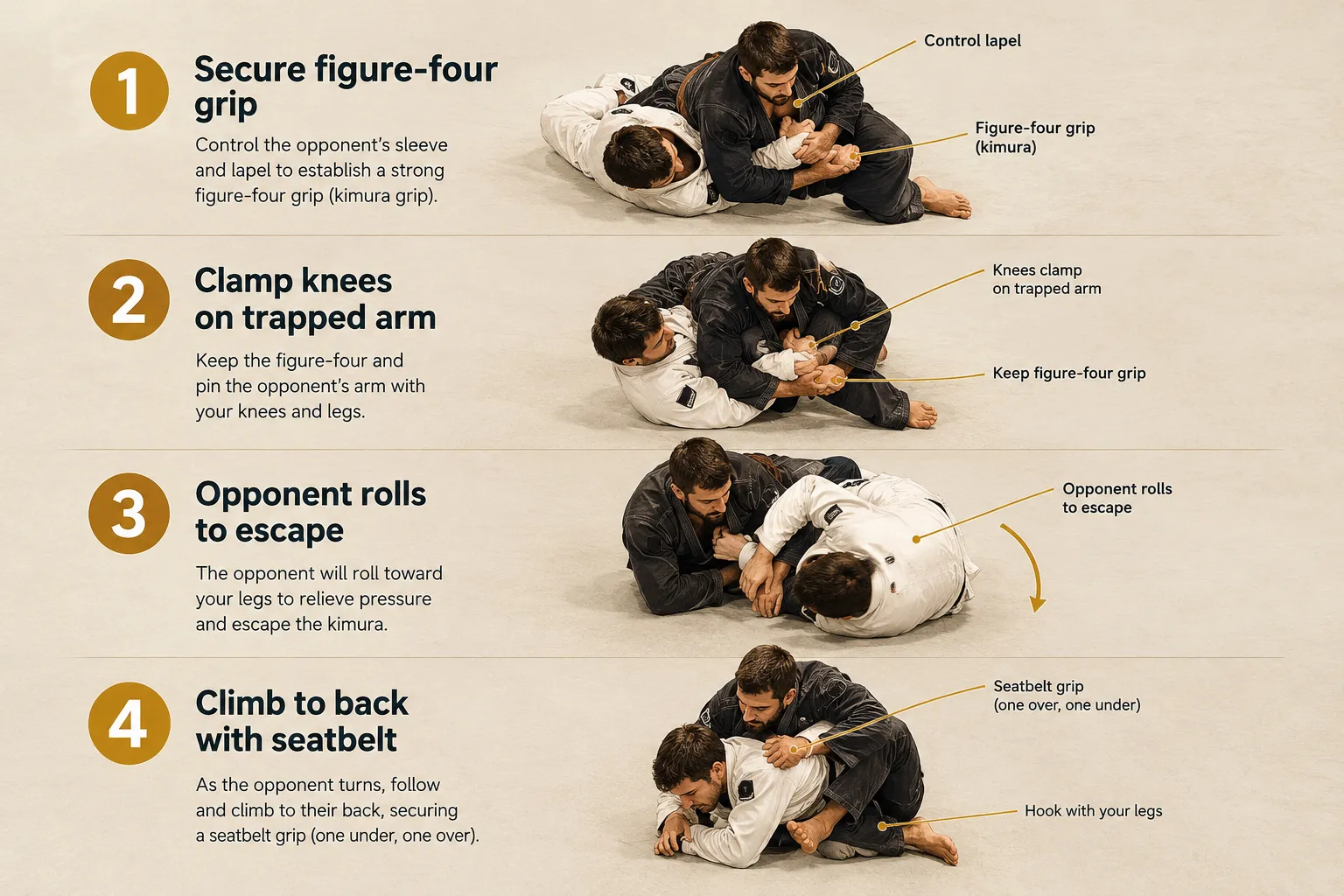
That same philosophy shows up from the bottom. A deep underhook paired with wrist control can lead into a leg-over-back figure-four and a rolling finish that creates what’s been called a three-way trilemma:
- They roll → you take the back.
- They base out → you sweep.
- They resist and stay still → you finish the kimura.
Key details that make this work: clamping your knees around the trapped arm so the opponent can’t simply pull it free, and genuinely threatening all three outcomes rather than committing early to one.[8][12, noted contextually] This is precisely why modern competitors describe the bottom half-guard kimura as their bread and butter, not because the submission rate is magic, but because the position forces a decision, and every decision the opponent makes opens something else.
Systematic curricula built by respected instructors echo this layered approach, teaching sweeps, submissions, and back takes from every major half-guard variation, knee shield, deep half, underhook half, and lockdown, rather than treating each as its own silo.[7] If you’re building a half guard game from scratch, studying how top position players try to shut this down is just as valuable; see our notes on half guard top defense to understand what you’re up against.
Chaining Instead of Hunting: How to Actually Build This Game
The single biggest mistake grapplers make with half guard submissions is treating them as isolated finishes to “hit” rather than links in a chain. The data from this year’s instructional landscape is consistent: submission threats from half guard make your sweeps more effective, because a real threat forces a defensive reaction, and that reaction is what creates the sweep or back-take window in the first place.[6]
A practical chain to drill:
- Establish the underhook and get to shoulder crunch or dogfight.
- Thread the kimura grip as your base control, not your only goal.
- Read the reaction: rolling → chase the back; basing → load the sweep; stalling → finish the kimura or transition to a knee bar if the leg is exposed.
- Never reset to zero. If one branch closes, the position you’re already in should open the next one.
This is also why free and commercial curricula increasingly treat half guard as a hub rather than a single guard, triangle setups, leg-lock progressions, and even X-guard transitions are now routinely built off the same underhook and knee-shield frames that power your sweeps. If you’re exploring related bottom-guard concepts outside half guard itself, the ideas behind Samurai From Quarter Guard follow a similar “control first, finish second” logic worth cross-training.
And don’t overlook the practical side of hard rolling sessions where you’re drilling these live, a properly fitted mouthguard matters when you’re working knee bars, scrambles, and back-take rolls at pace. Check our best BJJ mouthguard picks before your next hard training block.
Where This Is Headed
Given how many major 2026 releases converged on the same idea, knee bars folded into deep half, back takes built into every sweep sequence, kimura grips doubling as control systems, it’s a safe bet that 2027 brings even more specialized instructionals focused on knee-bar chains and structured back-take trees straight from reverse and deep half guard. The practitioners who adapt early, treating half guard as a hub of connected threats rather than a hunt for one finish, will be the ones setting the pace.
Conclusion
The old model of half guard, survive, sweep, maybe snatch a kimura if the arm’s exposed, has given way to something far more connected. Half guard submissions beyond the kimura are really about reading posture and underhook position, then letting the right tool present itself: a shoulder-crunch choke when they’re flat, a knee bar when they post, a back take when they roll. None of these exist in a vacuum, and none of them require you to abandon the fundamentals that got you here.
Start small. Pick one posture-based branch from this guide, say, the knee bar off deep half, or the back take off a stalling kimura grip, and drill it for a few weeks until the read becomes automatic. Then add the next branch. Come back and check it as you build out the rest of your half guard chain, there’s always another layer to add on the mats. Oss!
References
[1] Submissions Halfguard – https://www.bjjglobetrotters.com/category/videos/instructionals/halfguard/submissions-halfguard/ [2] Halfguard – https://www.bjjglobetrotters.com/category/videos/instructionals/halfguard/ [3] Half Guard Bjj – https://taipeibjj.com/half-guard-bjj/ [4] Half Guard Encyclopedia By Leo Nogueira – https://bjjfanatics.com/products/half-guard-encyclopedia-by-leo-nogueira [5] Instructionals – https://www.bjjglobetrotters.com/category/videos/instructionals/ [6] Best Bjj Instructionals Beginners – https://bjjgearguide.com/best-bjj-instructionals-beginners/ [7] Best Bjj Instructional For Blue Belt – https://bjjmore.com/best-bjj-instructional-for-blue-belt/ [8] Kimura Submission Setups – https://taipeibjj.com/kimura-submission-setups/ [9] Sweeps Halfguard – https://www.bjjglobetrotters.com/category/videos/instructionals/halfguard/sweeps-halfguard/ [10] News 20260729 Guide 12 Core Kimura Positions – https://letsbjj.com/en/news/news-20260729-guide-12-core-kimura-positions/
half guard, half guard submissions, kimura, knee bar, back take, deep half guard, shoulder crunch half guard, BJJ leg locks, underhook control, no-gi grappling, BJJ instructionals, submission grappling